




 10:16 AM

It is understood that all people in Myanmar are under military rulers abusing human right. But other people of Myanmar exclusive Burma ethnic are really under persecution and hardly condition for their futures more than as Burma suffer.
The Same under Military Rulers, Different Suffers

Remains of Dutch factory
Today Mrauk U is a small quiet town with a large number of pagodas and temples scattered all around. Unlike the people of Bagan, the inhabitants are still living among these religious edifices and have so far escaped expulsion.

Mrauk U - Arakan - From Schouten, Voyages (1676)
In 1406, the rightful king Meng Saw Mun had taken refuge in the neighboring sultanate of Bengal; he was not able to return to his throne until 24 years later, with considerable help from the Bengal ruler. In 1454, he founded a new captial in the north of Rakhine, Mrauk U. His successors gave trade and territorial concessions to Portuguese, receiving in return, Portuguese military support and help in building new fortifications. Empowered by this support, Mrauk U was able for a period to extend its area of influence west as far as Chittagong. Toward the end of 16th century, Rakhine pillaged Bago and ruled for a short time the entire Ayeyarwady delta.

Showing posts with label ARAKAN. Show all posts
Showing posts with label ARAKAN. Show all posts
Monday, June 4, 2012
Three Suspected culprits of rape and murder in Rambree arrested

Victim Ma Thidar Htwe 26 year old(http://www.arakanlaywaddy.com/)
Rambree: Three suspected culprits who allegedly committed the crimes of rape and murder in Rambree in Arakan State were reported to be arrested by the police on the night of 29th May after the local peoples gathered at the local police station and demanded them to reveal and arrest the culprits.
The arrested are identified as Htak Htak (23), Rafique (18) and Luyub (21) from Kyaukhtaran Muslim Village in Rambree Township.
Htak Htak was said to be arrested with the victim’s jewelries in downtown Rambree first and his two other associates in the crime were also arrested on the same night from their residences in Kyaukhtaran Village.
“All three culprits are already arrested. People from 11 villages in our area marched to police station in Kyauknimaw and staged a demonstration demanding immediate identification and arrest of the culprits. So, the police immediately identified and arrested the culprits”, said a resident from Kyauknimaw.
He said nearly 1,000 villagers from eleven nearby villages participated in the demonstration demanding police action against the culprits who committed the crime.
“That’s the most heinous crime that may lead to a big problem in our area. The people are raged with anger and indomitable spirit. Not only the police, but also district and township administrations had to prevent the people. Otherwise the crime could spark a very big communal unrest”, he said.
The source also said the police forces had to save two other Muslim youths as the angry crowd tried to get rid of them, believing them to be the offenders of the crime while they were being interrogated on suspicion of the crime in the residence of Kyauknimaw Villager Administrator, U Than Tun.
Those three arrestees were said to be sent to Kyaukpru district prison on the same night they were arrested because of the worrisome situations for them in Rambree.

http://www.arakanlaywaddy.com/
Police in Kyauknimaw police station confirmed the arrest of three youths but denied to tell details about the case.
Kyauknimaw Village is today quiet and its market that used to be crowded is dry without people. There is no traffic between the nearby villages and especially no Muslim dares to go out from their homes in the area.
The victim is identified as 26 year old Ma Thidar Htwe from Thapraychaung Village in Rambree Township. She was said to be raped and killed by those three Muslim youths on her way back home after working in Kyauknimaw Village around 5 pm on May 28. According to the eye-witnesses, her dead body bears a slice at the throat, several stabs on the chest, and stabs and cuts on the vagina and pubic region.
The victim’s dead body will be cremated in the afternoon on the 30th of May under the supervision of the local authorities reportedly to avoid any social unrest in the area.
Reportedly said that Kyaukhtayan village is a place where a number of Bengali reside, experts on immigration issues view the case that it has a very high possibility of social conflicts if police and civil administrators can't control the situation very well. Meanwhile, a Rakhine activist claims that such cases are likely to be due to weaker control and corruption of regional police forces on immigration problems. Bengali immigrants are also called as Rohingyas.
Sources;

Three suspected culprits of rape and murder in Rambree arrested
Rambree: Three suspected culprits who allegedly committed the crimes of rape and murder in Rambree in Arakan State were reported to be arrested by the police on the night of 29th May after the local peoples gathered at the local police station and demanded them to reveal and arrest the culprits.
 The arrested are identified as Htak Htak (23), Rafique (18) and Luyub (21) from Kyaukhtaran Muslim Village in Rambree Township.
Htak Htak was said to be arrested with the victim’s jewelries in downtown Rambree first and his two other associates in the crime were also arrested on the same night from their residences in Kyaukhtaran Village.
“All three culprits are already arrested. People from 11 villages in our area marched to police station in Kyauknimaw and staged a demonstration demanding immediate identification and arrest of the culprits. So, the police immediately identified and arrested the culprits”, said a resident from Kyauknimaw.
He said nearly 1,000 villagers from eleven nearby villages participated in the demonstration demanding police action against the culprits who committed the crime.
“That’s the most heinous crime that may lead to a big problem in our area. The people are raged with anger and indomitable spirit. Not only the police, but also district and township administrations had to prevent the people. Otherwise the crime could spark a very big communal unrest”, he said.
The source also said the police forces had to save two other Muslim youths as the angry crowd tried to get rid of them, believing them to be the offenders of the crime while they were being interrogated on suspicion of the crime in the residence of Kyauknimaw Villager Administrator, U Than Tun.
Those three arrestees were said to be sent to Kyaukpru district prison on the same night they were arrested because of the worrisome situations for them in Rambree.
 Police in Kyauknimaw police station confirmed the arrest of three youths but denied to tell details about the case.
Kyauknimaw Village is today quiet and its market that used to be crowded is dry without people. There is no traffic between the nearby villages and especially no Muslim dares to go out from their homes in the area.
The victim is identified as 26 year old Ma Thidar Htwe from Thapraychaung Village in Rambree Township. She was said to be raped and killed by those three Muslim youths on her way back home after working in Kyauknimaw Village around 5 pm on May 28. According to the eye-witnesses, her dead body bears a slice at the throat, several stabs on the chest, and stabs and cuts on the vagina and pubic region.
The victim’s dead body will be cremated in the afternoon on the 30th of May under the supervision of the local authorities reportedly to avoid any social unrest in the area.
Victim Ma Thidar Htwe 26 year old
Htak Htak was said to be arrested with the victim’s jewelries in downtown Rambree first and his two other associates in the crime were also arrested on the same night from their residences in Kyaukhtaran Village.
“All three culprits are already arrested. People from 11 villages in our area marched to police station in Kyauknimaw and staged a demonstration demanding immediate identification and arrest of the culprits. So, the police immediately identified and arrested the culprits”, said a resident from Kyauknimaw.
He said nearly 1,000 villagers from eleven nearby villages participated in the demonstration demanding police action against the culprits who committed the crime.
“That’s the most heinous crime that may lead to a big problem in our area. The people are raged with anger and indomitable spirit. Not only the police, but also district and township administrations had to prevent the people. Otherwise the crime could spark a very big communal unrest”, he said.
The source also said the police forces had to save two other Muslim youths as the angry crowd tried to get rid of them, believing them to be the offenders of the crime while they were being interrogated on suspicion of the crime in the residence of Kyauknimaw Villager Administrator, U Than Tun.
Those three arrestees were said to be sent to Kyaukpru district prison on the same night they were arrested because of the worrisome situations for them in Rambree.
Police in Kyauknimaw police station confirmed the arrest of three youths but denied to tell details about the case.Kyauknimaw Village is today quiet and its market that used to be crowded is dry without people. There is no traffic between the nearby villages and especially no Muslim dares to go out from their homes in the area.
The victim is identified as 26 year old Ma Thidar Htwe from Thapraychaung Village in Rambree Township. She was said to be raped and killed by those three Muslim youths on her way back home after working in Kyauknimaw Village around 5 pm on May 28. According to the eye-witnesses, her dead body bears a slice at the throat, several stabs on the chest, and stabs and cuts on the vagina and pubic region.
The victim’s dead body will be cremated in the afternoon on the 30th of May under the supervision of the local authorities reportedly to avoid any social unrest in the area.
Tuesday, October 25, 2011
Arakan & Arakanese
What is Arakan: Rakhine, Rakhaing or Rakhaing-pray?
The land that is known as Arakan by the foreigners is called "Rakhaing-pray" by its own peoples, Rakhaing-thar (Arakanese). The Arakanese history records the early Arakanese to migrate in Arakan and settled down in their true land since time immemorial.
According to the Arakanese chronicles, the name Rakhaing (Rakhine) was originated from Pali word Rakhapura meaning the land of the people of Rakhasa (Rakhasa > Rakkha > Rakkhaing > Rakhaing) who were titled this name in honour of preservation on their national heritage and ethics or morality (Sila).
In the past Arakan was known as Thuwannapura, Ramathuwannapura, Ayujjhapura, Rakkhapura, Dynyawaddy, Mahawihika and Mahinthakamandala. According to tradition Indo-Aryan people reached Arakan from India Gangha delta and settled in Kaladan Valley at the very early time. Before migrating to Arakan, those Indo-Aryan are thought to have mixed and intermarried with a migrant Mongoloid tribe in eastern India and Arakan. An eminent Arakanese archaeologist, U San Shwe Bu, pointed out that the Indo-Aryan came to Arakan from Majjhimadesa who were living on the bank of river Ganges. Moreover, ancient Arakanese belonged to Magadha region as their ancestral places who later settled in Arakan region and consequently found their first capital city at Dynyawaddy. The Dynyawaddy was classified in three different ages known as the first Dynyawaddy (3325- 1483B.C.), found by Marayu, the second Dynyawaddy (1483-580 B.C.) by King Kanrazagree; the third Dynyawaddy (580-B.C. to 326 A.D.) was found by King Canda Suriya. The second period in history of Arakan was Vesali Kyauk-HleGarr (327-818) found by Dven Candra, and the history recorded the highest civilization in the Bay of Bengal had thrived with the international trade and commerce. Gold and silver coins of five denominations were used.
Located east of Vanga and Smatata of ancient India of which great religion, culture and politics had enormous influenced on the Arakanese people since immemorial. The historians believed that the Mongoloid race in Arakan was mostly inter-related with Indo-Ariyans, who came over and probably ruled the native population, gradually impressing on their culture and religion. Arakanese chronicles said that the name of Rakhine was originated from Pali word Rakkhapura meaning the land of Rakasha, Rakhasa, Rakkha, Rakkhaing, who are titled this name in honor of preservation on their national inheritance and moral values.
True to this stanza, as illustrated in the Buddhawan-an ancient Arakanese script, the Arakanese (Rakhines) heroically lived in their ancient homeland of Arakan state devoting to safeguard the two essential qualities, namely nationality (Amyo) and morality (Sila). Above classical verse illuminated how the true nature of the Arakanese way of life and their highest expectation is to achieve the ultimate goal of Nirvana. The Buddhist ecumenical outlook and way of life seems to have enough scope for adjustment and subsequence change of indigenous believes and practices, so that religion became swiftly acknowledged by the local inhabitants but was able in the process to bring about harmonious development in social values and traditions in the nation as a whole.
The remoulding of Arakanese Buddhism took place in the social background of Arakan's unfolding society which played a determined role in giving shape to the characteristic features of Arakanese society. Buddhism has long been an important part of the cultural heritage of Arakan, and it flourished in Arakan receiving royal patronage. It has not been a mere system of believes to Arakanese; it encompasses the entirety of our culture and civilization and national character the very essence of our lives. Of all the bonds, which defined Arakanese as the people as a nation, religion was undoubtedly strongest. Arakanese national identity becomes indistinguishable from its religion. It is undeniable fact to say that everyday life of an Arakanese from the cradle to grave, together with his art and craft and literature and culture, and arts other element of his life, are all based upon and moulded by the one common factor, the spirit of Buddhism.
The advent of Buddhism in the 6th century B.C. was an epoch-making event not only in the history of Indo-Arakan sub-continent, but also it was in the history of the world. We know very little about pre-Buddhist India. The historical materials on the basis of which ancient history has been written are scanty. The true historical knowledge, which we gather, is from the time of the Buddha. The most authentic sources of ancient history are the inscription, copperplates, coins, traveler's reports, historical accounts, and religious texts from various religions. Out of them, the inscriptions, coins, and copperplates are associated with the epigraphic records of ancient time. The Greek Ambassadors and Chinese travelers have left valuable accounts relating to Indian sub-continent.
Arakanese claimed to be the first state in Asia to have received Buddhism from India. In fact, Arakan’s historical traditions are inseparably interlined with Buddhism from India. It is known that the early Buddhists of India had a strong inclination to carry their religion, and with it their civilization into the Arakan region which lay immediate frontiers. There can be not doubt either those Buddhist adventures, traders and missionaries managed to reach the Arakan region at very early period even before the advent of Christian era. These adventures, missionaries, and their followers brought with them the arts of civilization which were laid the foundations of political and cultural history of Arakan.
Most of the Arakanese chronicle sources unanimously state that Buddhism, which had existed during the reign of Sanda Suriya, who dedicated the illustrious Maha Muni Image in B.C. 554, has become the prime faith the phenomenon now called Buddhism in Arakan which began its gentle progress to farthest reached of the globe. Ancient Arakanese legendary gives detail accounts of King Sanda Suriya who endowed the great shrine Maha Muni on the occasion of Lord Buddha landing to Arakan in 123 Bowdaw Inzana Era, 25 years before Buddha's Mahaparinibbana. The Buddha visited to Arakan expressly to enable King Sanda Suriya to build a life-size image of himself and Buddha blessed on alighted on the top of Thelagiri Hill situated the east of Kyawtaw on the bank of Kaladan. The Buddha had parted His Holiness teeth emitted rays of light that shone forth with a dazzling vividness in all directions, and to the reverend Ananda, his beloved cousin. He blessed the wishful remarks: "Danyawaddy is great and splendid country which shall have ninety-nine towns on its eastern bank of the Gacchapanadi and ninety-nine towns on its western bank. Its kings shall continue to be the ancient Kshatriya stock and particularly our Sakya race has been descended from Ajjuna Hermit-King of Kapilavastu. As a Bodhisattva, I was reborn many a times here; I shall have in this noble country; my own image built that shall enclose in this land for 5000 years during the life of my Sasana or Buddhism". Arakanese were justly claimed to be the first in Asia outside India to have heard the word of the Buddha that was too from his His Holiness lips. When the image was finished, it was established in Thiriguta Hill amidst universal rejoicing when gods and men could mingle freely to worship the great image of Maha Muni.
How deeply intertwined the image of Maha Muni was in the heart of Arakanese might be gathered from the following classical passage in poem Arakanese Princess Egyin written by Badu Mong Nyo in 15th century.
Information regarding early introduction of Buddhism in Arakan is from two sources; first from the archaeological discoveries and the second from the records of Arakanese literature. From archaeological evidence, we find a number of symbols that are of religious significance, special to Buddhism. Perhaps most importantly, there have been discovered several image stone figures. An ancient stone inscription in Nagari character was discovered by renowned Archaeologist Dr. Forchhammer. Known as Salagiri, this hill was where the great teacher came to Arakan some two thousand five hundred years ago. Somewhere from eastern part of this hill, a stone image in Dhamma-cakra-mudra now kept in Mrauk-U museum, was found earlier in 1923. This relief sculpture found on the Salagiri Hill represents Buddha preaching King Canda Suriya belongs to 4th century A.D.; five more red sandstone slabs with the carving were found close by the south of this Salagiri Hill in 1986. They are the same type as the single slab found earlier in 1923. These carving slabs of Bhumispara-mudra, Kararuna-mudra, Dhammacakra-mudara, and Mmahaparinibbana-mudra represent the life of Buddha.
These sculptures provide earliest evident about the advent of Buddhism into Arakan; during the life time of the Buddha and these discoveries were therefore assumed as the figures of King Canda Suriya of Dyanawady, who dedicated the Great Maha Muni Image. These archaeological findings have been studied by eminent scholars and conclusion is that the Maha Muni was made during the king Sanda Suriya era. But some historians and scholars viewed the creation date of Maha Muni shrine still remains a mystery and the lack of comprehensive data, and this subject remains controversy till date.
The oldest artifact, stone image of Fat Monk inscribed "Saccakaparibajaka Jina" in Brahmi inscription comes to the date of first century A.D.; the stone inscriptions are of Sanskrit, Pali, Rakhine, Pru and Arabic languages. The cubic stone inscriptions record the peace making between the governor of Thandaway Mong Khari (1433-1459) and Razadhiraj the Mon Emperor in Arakanese inscription. This was found from a garrison hill at the oldest site of Parein. A stone slab with the alleged figure of the Buddha preaching, King Canda Suriya bored testimony to the Salagiri tradition, depicting of the advent of the Teacher to Dyanyawaddy.
Since after receiving Buddhism and uninterrupted Buddhist tradition has been in the main fabric of the Arakan society which was influenced by Indian Buddhist tradition and culture as evident from important Arakanese historical sources and archaeological findings in the region. Monumental edifices, inscriptions, pagodas and images of the Buddha discovered in Arakan are compelling evident-witness to the prosperity of kingdom. Located in various ancient royal sites, the edicts and inscriptions of each king -clear indication of personality and heritage along with the pious activities-he had performed in support of the Buddhist religion during his reign. Even today mouldering ruin of ancient statue and pagoda in almost parts of Arakan are surviving example of what was once architectural genre. The principal pagodas and monasteries once a lofty and richly decorated structures, still stand and pitifully through. Others stupas, monasteries, pillared halls, shines, railing, and original established parts all over the country have been ruined to the ground level. A number of archaeological treasures have been stolen and many have been broken into the pieces. Many have savagely ruined by man and nature. Some are left out as a witness to the original grandeur of the Chaitya.
Anandacandra Inscriptions date back to 729 A.D. originally from Vesali now preserved at Shitethaung indicates adequate evidence for the earliest foundation of Buddhism. Dr. E. H. Johnston's analysis reveals a list of kings which he considered reliable beginning from Candra dynasty. The western face inscription has 72 lines of text recorded in 51 verses describing the Anandacandra's ancestral rulers. Each face recorded the name and ruling period of each king who were believed to have ruled over the land before Anandacandra. Archaeology has shown that the establishment of so many stone pagodas and inscriptions which have been totally neglected for centuries in different part of Arakan speak of popular favored by Buddhism.
The crowing event in the history of Arakan was the Convention of the Buddhist Council at the top of golden hill of Vesali under the royal patronage of King Dhammawizaya in 638 AD. through joint effort of two countries, Arakan and Ceylon. This momentous triumph of the great council was participated by one thousand monks from Ceylon and one thousand monks from Arakan kingdom. As a fitting celebration of the occasion, the lavish construction of pagodas, statues and monasteries were undertaken for the purpose of inscribing the Tripitaka. After Vesali, Pyinsa was found by Lemro dynasty in 818 A.D; the great king of dynasty (AD. 818 -1430) was King Mim-Yin-Phru, who turned his attention towards the development of Buddhism, and in 847 A.D. he conveyed the second Buddhist council in Arakan attended by 800 Arahants. Arakanese chronicles report that therein the Tripitaka and Atthakatha were incribed on the golden plate and enshrined. Never has there been impediment in the practice of Theravada Buddhist faith since it has introduced in Arakan. The copious findings of inscription Ye Dhamma verse were practical evidence that Theravada was dominant faith if epigraphic and archaeological sources were to be believed. The Royal patronage has always been significant factor contribution to stability and progress of the religion in Arakan.
Mrauk-U, the last kingdom of independent Arakan founded by King Mong Saw Mon in 1430, has become the principle seat of Buddhism, has reaching at zenith of the golden age. Mrauk-U was divided into three periods: the earliest period (1430-1530), the middle period (1531-1638), and the last period (1638-1784). In Arakan antiquities at the Mrauk-U seems to give rational evidence as to where Buddhism was settled down. These include stone inscriptions, Buddha images, the Buddha's foot-prints and the great pagoda itself which, stripped its later-constructed top, would be of the same design as the Gupta style of ancient India.
Now how far these accounts are credible for the modern scholars? Arakan is the only state in Southeast Asia to be geographically connected to India by both land and sea route which is considered as the transition center of spreading Buddhism to Southeast Asia. There can be no denying factor that Buddhism has been great cultural forces in Arakan and rallying point for Buddhists over the world. Ancient Indian historians concluded that eastern regions of India were always regarded culturally and strategically as part of India, and the rest of the territory remained Indian in culture and predominantly within geopolitical orbit of India. The famed Chinese traveler Hiuen Tsan recorded in his travel account that one of Chinese monks; a priest of King-Chau (in Hupeh) of China went to India by southern sea-route and arrived at A-Li-Ki-Lo known as Arakan. A-Li-Ki-Lo (Arakan) was the eastern limit of India. It was part of Jambudipa. Bing ancient geographical part of Jambudipa, Arakan exists as a contiguous land with India, and thus Indian civilization has spread over Arakan since the very beginning of Arakan history. This geographical proximity and Arakanese literature records are more historical realistic and considered that Buddhism had spread to Rakkhapura before Asoka period of India.
It has become customary with modern scholars to play a double role. On one hand, they use Arakanese sources for their research material. On other hands, they neglect the significance of the narratives in Arakanese sources. Whatever historical enlightenment modern scholars could get from the Arakanese sources, they avail of it while they cast aside whatever they do not find their own liking, branding it as neither “nationalism”, “mysticism” or “mistake”. This seems to be unfair and misinterpretation to the spirit of Arakanese authority and the value of their national treasure.
By dismissing the long-settled Arakanese theories on such an important subject of Buddhism which has arrived to this region formerly part of Jambudipa earlier before commencement of Christian era, in fact Sappadanapakarana-a palm leaf manuscript found by Dr. Forchmer gives interesting accounts that the Buddha with 500 Arahans came to Dynyawaddy by aerial journey. The earliest known artifacts discovered were a Fat Monk dating back to first century A.D. and other Buddha images preaching to King Canda Suriya, and the earliest important inscription found at Taung-paukgree village are good sources to be believed that Buddhism had existed in Arakan during reign of Canda Suriya. On the other hands, vast collection of less known Arakanese literatures are great volume to be examined if literature sources are to be believed, and archeological unearthed are the foremost symbol of earliest Indian Buddhist civilization link to this region, as geographical proximity between India and Arakan is still unquestionable. But some outside observers do not seem to accept these indications of Arakan preserved. According to Arakanese chronicle sources, Buddhism have been arrived to Arakan first by visiting Buddha himself with five hundred Arahants in 554 B.C. and subsequently by arriving missionaries sent by Asoka in third century B.C; it is not that easy, as it might seem to the modern scholars who are working in consultation with Arakanese sources. If they find the materials inconceivable, and then either they should not go after it, or they should refute it in clear terms, and that is they do should do. Their position therefore is far from satisfactory. Their attitude has the shortcoming of the outsider’s approach. They have not been able to show any grasp of the Arakan way of opinion and currently have only managed to come with sarcasms.
To give an example, when an Arakanese historian simply says that the Maha Muni Image was made during the life time of the Buddha, he is regarded as an authority; but when he enters into details with traditional background and with its original literature source, he is said making mistake. What is that? Should one say so, without having looked deeper into the significance of scholar’s statement that might have been made on logical and historical grounds? In fact, statements occurring in older classics cannot be interpreted in a straightforward manner--we live in a world different from that of theirs and that has intervened a shift of linguistic and idiomatic convention, followed by revolutionary changes in the concept of science and technology. What one should do in respect of philosophical classics is to adopt an objective and unbiased attitude. It may quite well be the fact that the complex statements which were once reasonable and intelligent. Before we come to say that they are “discreditable”, we should first consider the possibility that the statement could be interpreted to have some forgotten sociological implication. We should have the tolerance to wait till the so-called incomprehensible statements are finally settled by endeavoring and persevering scholars. Such an honest attempt by the scholars concerned is badly needed today, especially for Arakan history research.
A scholar, desirous of knowing the history and culture of ancient Arakan, can in no way discount an enormous treasure of Arakanese literatures. They have been partially laid down contribution of a large volume of worthy still lies buried to be translated into other languages, which the scholars have not yet explored. A careful study of them will be a valuable contribution not only in the sphere of influence of Buddhist literature, but also on Indian history, civilization, and culture of India and Arakan. Arakan, thus, proves to be in some respects as important an apparatus for the study of certain periods of Indian civilization as language of that subcontinent. At the same time, the process of the contribution of Buddhism and assimilation of Indian culture in Arakan proves us with extraordinary interesting and historical valuable example should prove another culture and religion without totally forsaking its own deeply rooted tradition. Scholarly venture upon various aspects of Arakan is, therefore, desirability. This pious task may very well be shouldered by the scholars.
In the circumstantially, the Arakanese are left with no other means than either to surrender to the impositions of the modern scholars as mentioned above, or to refute their views by appealing to logic and history and to start to do scientific research maintaining the culture, literature and spiritual heritage which is based on the teaching of the Buddha and pristine legacy of Arakan. Nothing greater can be said to credit the Arakanes' appeal of the teaching of Buddha and their commitment to safeguard to their ancestral land and the pristine faith of Buddhism.
After introduction of Buddhism to Arakan, history records, how it has been preserved by the Arakanese with the patronage of rulers, as the greatest national treasure to be protected, interpreted, followed, and propagated. Even through during the colonial periods, the protection of this has continued to be the main policy of Buddhist Arakan, which has taken a leading role in nationalist movements for their freedom. Downfall of Arakan independence suffered a great lost of Arakanese Buddhism at hands of vandals, and it was an undeniable truth of history: the victors destroyed symbols of ancient civilization in Arakan to stamp their future on conquests. Since 1785 onwards the painful legacy of colonial rule has brought Arakanese to untold miseries and thousands of Arakan's historical statues and precious artifacts that have lost forever. Among them, the lost of Maha Muni was the greatest sorrowful to the Arakanese than the lost of their independence, as the Arakanese themselves resolutely regarded that their devoted life and the Maha Muni were inseparable by any mean. The victors may take the Maha Muni as booty in the name of conquest but they can never break the spirit of Arakanese to demand nothing less than---it is immortal legacy of Arakan given by the Buddha---it is traditionally unquestionable. The belief in and sentimental attachment of Buddhism and unshakable adoration to Maha Muni could not be erased from their mind and replaced by one another.
Even today, the very holy name of Maha Muni always lives as legacy in the hearts of Arakanese although it has taken away from its birth place of Dynyawady to Burma, which is now enshrined in Mandalay, and it is considered as the oldest sole surviving legacy and is one of the most important sacred images in the Buddhist history of Southeast Asia. Being landmark historical testimony towards the presence of the greatest of mankind has ever witnessed the fame of Maha Muni as the heart of prime faith inspired countless people throughout its history and given the most enduring legacy of pride to the Arakanese in Buddhist world. Indeed, nation as whole owes much to the religion and Arakanese wholeheartedly acknowledging their indebtness to Buddha's teaching. It is therefore not surprising that the Arakanes are always obliged to be cherished and to be proud of belonging to THE LAND OF THE MAHA MUNI, whose legacy is universal truth.
Thezin pan khaing ta mraing mraing
Rakhine phara paung.
The Thazin's sprigs in cheer clusters
Sum the total of Rakhine phara grandeur.
(U Tha Hla, The Rakhaing Vol. (I) No. (7)
Not only Arakan is rich in natural resources, but it is also rich in the establishment of the Buddhist monasteries, pagodas which play a very creative role to development of Arakanese culture and civilization. Arakan offers some of the richest archaeological sites in the Southeast Asia. A number of Buddhist landmarks erected by the Arakanese are still be found intact or the archaeological ruins under the earth. In the city of golden Mrauk-U there are scattering innumerable temples and pagodas which preserved as places, thereby exerting a great influence on spiritual life of the people.
Arakanese chronicle records that more than six million shrines and pagodas flourished in Mrauk-U. In fact, they formed the pride of golden Mrauk-U. Dr. Forchhammer described in his Arakan, "in durability, architectural skill, and ornamentation the Mrauk-U temples far surpass those on the banks of Arrawaddy". Buddhist arts both in the field of architecture and Buddha-image constructions are on the same line of flourishing. An illustrative example of this fact can be seen in the temple of Chitthaung pagoda and colossal Dukekanthein temple. Hence Arakan with its rich legacy has been able to achieve a great success in enriching and disseminating their culture and civilization. Even at the present, these cultural heritage lives sources are precious legacies of sacred symbols of Buddhism since the Arakanese are conscious of the contributions of their country towards the growth and development of their culture, literature and spiritual heritage, they are anxious to see their ancestral land once more restored to its pristine glory.
These truths to be the self- evident, Arakanese adopts religion in their totality and ever since has been giving them as a consummate taste of spiritual life. Buddhism is the religion of the mainstream of the people of Arakan, and it is pervading force in Arakanese society. The propound influence of religion can be seen in Arakanese life-style, mannerism, tradition, character, art, architecture, language, and all other aspects of the Arakanese culture. Religion has become to integrate in providing basis unity of Arakanese people that unfold itself as a creative force that inspires them to higher goals of achievement. How Arakanese had decisively upheld Buddhism and how they were impressed by Buddha's teaching that is to the Arakanese Buddhism means their entire life, and fulfillment---holding near and dear to them---while Arakan to be very truly is the Land of the Great Image, deserving its blessed legacy of Buddha.
The land that is known as Arakan by the foreigners is called "Rakhaing-pray" by its own peoples, Rakhaing-thar (Arakanese). The Arakanese history records the early Arakanese to migrate in Arakan and settled down in their true land since time immemorial.
According to the Arakanese chronicles, the name Rakhaing (Rakhine) was originated from Pali word Rakhapura meaning the land of the people of Rakhasa (Rakhasa > Rakkha > Rakkhaing > Rakhaing) who were titled this name in honour of preservation on their national heritage and ethics or morality (Sila).
Arakanese History at a Glance
The independent and sovereign Buddhist Kingdom of Arakan had been splendidly flourishing from 3325 BC. till the Burman invaders occupied it in 1784 AD.
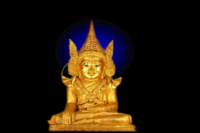
The Mahamuni Buddha Image (which was brought to Mandalay during the Burmese 1784 occupation), the utmost ancient and sacred Buddhist statue of World Buddhism, symbolised the heart and sovereignty of Arakan and its people, Arakanese. Thus, the country was called by "The Land of Great Image" in the foreigners' records. Besides that, millions of magnificent Buddhist pagodas, temples, statues and Buddha relics have been prevailing in the ancient capital cities of Arakan such as Dhanyawaddy, Vesali, Laemro and Mrauk-U.
The well-known traditional Saying in both Arakan and Burma "thazon pan-khaing ta-mraing-mraing Rakhaing phara paung" indicates that total number of Buddhist pagodas in Rakhine-pray (Arakan) is up to more than six millions (6,352,755).Religious harmony in the independent-sovereign Arakan Kingdom was remarkable. Annual contributions of the Arakanese Kings to all religious are acknowledged their respect to secularism though they all are authentic Buddhists.
Even though Arakan had reached zenith of power in the Bay when it was under the rule of the skilled and powerful kings, the country's glory and fame has steadily declined when it was succeeded and ruled by the unqualified kings. Chittagong, a part of Arakan was invaded and occupied by the Moghal in 1666 AD. And internal instability and dethroning of kings happened very often in Arakan Court. Taking opportunity in the overall weakness inside the country, the Burmese King U Wine violated the good-friendly neighbour's ethics and dispatched his invading forces into Arakan in mid-November, 1784 and occupied it by the end of 1784.
The national independence of Arakan and sovereignty of the Arakan Kingdom were lost on 31 December 1784 (7 waxing day of Pratho 1146 AE.) when it was invaded and subjugated by the Burman King Maung Wyne. The people of Arakan became enslaved. The national flag hoisted in honour of the nation on the top of the Royal Assembly Hall was dropped. The dignity, the honour and the prestige of the Rakhine as a FREE NATION had terminated immediately after loss of independence.
Arakan: A Promised Land
Arakan, a land which cherishes Buddha's principles of moral code, tranquility, love, compassion and wisdom, has patronized Buddhism for more than two millenniums, was the seat of an ancient sovereign country and religion, the nursery of art, and the center of the Buddhist stronghold. Myriad ancient pagodas and vast ruins of priceless archaeological treasure scattered all over the country are glorious symbols of past and are the present great recollections of the people of Arakan. Many are still buried and under the earthed. The large number of statues and pagodas gives one of an example of Buddhist art, but also makes it one of the richest repositories of sculpture in Arakan. Buddhism has been the national religion of Arakan and the epic center for the transmission of faith to Southeast Asia. The insightful influence of the Buddhism has been compelling testimony that can be seen in Arakan from the hill sides dotted with the pagodas, the symbols of yellow robe, the religious order of monks, and monasteries in almost every village shaping the character of the village people and their institutions. Since the region has been isolated from the rest of world for centuries and has remained and preserved unique customs and traditions in addition to Arakan’s own history, and religion which had existed since the dawn of civilization.In the past Arakan was known as Thuwannapura, Ramathuwannapura, Ayujjhapura, Rakkhapura, Dynyawaddy, Mahawihika and Mahinthakamandala. According to tradition Indo-Aryan people reached Arakan from India Gangha delta and settled in Kaladan Valley at the very early time. Before migrating to Arakan, those Indo-Aryan are thought to have mixed and intermarried with a migrant Mongoloid tribe in eastern India and Arakan. An eminent Arakanese archaeologist, U San Shwe Bu, pointed out that the Indo-Aryan came to Arakan from Majjhimadesa who were living on the bank of river Ganges. Moreover, ancient Arakanese belonged to Magadha region as their ancestral places who later settled in Arakan region and consequently found their first capital city at Dynyawaddy. The Dynyawaddy was classified in three different ages known as the first Dynyawaddy (3325- 1483B.C.), found by Marayu, the second Dynyawaddy (1483-580 B.C.) by King Kanrazagree; the third Dynyawaddy (580-B.C. to 326 A.D.) was found by King Canda Suriya. The second period in history of Arakan was Vesali Kyauk-HleGarr (327-818) found by Dven Candra, and the history recorded the highest civilization in the Bay of Bengal had thrived with the international trade and commerce. Gold and silver coins of five denominations were used.
Located east of Vanga and Smatata of ancient India of which great religion, culture and politics had enormous influenced on the Arakanese people since immemorial. The historians believed that the Mongoloid race in Arakan was mostly inter-related with Indo-Ariyans, who came over and probably ruled the native population, gradually impressing on their culture and religion. Arakanese chronicles said that the name of Rakhine was originated from Pali word Rakkhapura meaning the land of Rakasha, Rakhasa, Rakkha, Rakkhaing, who are titled this name in honor of preservation on their national inheritance and moral values.
True to this stanza, as illustrated in the Buddhawan-an ancient Arakanese script, the Arakanese (Rakhines) heroically lived in their ancient homeland of Arakan state devoting to safeguard the two essential qualities, namely nationality (Amyo) and morality (Sila). Above classical verse illuminated how the true nature of the Arakanese way of life and their highest expectation is to achieve the ultimate goal of Nirvana. The Buddhist ecumenical outlook and way of life seems to have enough scope for adjustment and subsequence change of indigenous believes and practices, so that religion became swiftly acknowledged by the local inhabitants but was able in the process to bring about harmonious development in social values and traditions in the nation as a whole.
The remoulding of Arakanese Buddhism took place in the social background of Arakan's unfolding society which played a determined role in giving shape to the characteristic features of Arakanese society. Buddhism has long been an important part of the cultural heritage of Arakan, and it flourished in Arakan receiving royal patronage. It has not been a mere system of believes to Arakanese; it encompasses the entirety of our culture and civilization and national character the very essence of our lives. Of all the bonds, which defined Arakanese as the people as a nation, religion was undoubtedly strongest. Arakanese national identity becomes indistinguishable from its religion. It is undeniable fact to say that everyday life of an Arakanese from the cradle to grave, together with his art and craft and literature and culture, and arts other element of his life, are all based upon and moulded by the one common factor, the spirit of Buddhism.
The advent of Buddhism in the 6th century B.C. was an epoch-making event not only in the history of Indo-Arakan sub-continent, but also it was in the history of the world. We know very little about pre-Buddhist India. The historical materials on the basis of which ancient history has been written are scanty. The true historical knowledge, which we gather, is from the time of the Buddha. The most authentic sources of ancient history are the inscription, copperplates, coins, traveler's reports, historical accounts, and religious texts from various religions. Out of them, the inscriptions, coins, and copperplates are associated with the epigraphic records of ancient time. The Greek Ambassadors and Chinese travelers have left valuable accounts relating to Indian sub-continent.
Arakanese claimed to be the first state in Asia to have received Buddhism from India. In fact, Arakan’s historical traditions are inseparably interlined with Buddhism from India. It is known that the early Buddhists of India had a strong inclination to carry their religion, and with it their civilization into the Arakan region which lay immediate frontiers. There can be not doubt either those Buddhist adventures, traders and missionaries managed to reach the Arakan region at very early period even before the advent of Christian era. These adventures, missionaries, and their followers brought with them the arts of civilization which were laid the foundations of political and cultural history of Arakan.
Most of the Arakanese chronicle sources unanimously state that Buddhism, which had existed during the reign of Sanda Suriya, who dedicated the illustrious Maha Muni Image in B.C. 554, has become the prime faith the phenomenon now called Buddhism in Arakan which began its gentle progress to farthest reached of the globe. Ancient Arakanese legendary gives detail accounts of King Sanda Suriya who endowed the great shrine Maha Muni on the occasion of Lord Buddha landing to Arakan in 123 Bowdaw Inzana Era, 25 years before Buddha's Mahaparinibbana. The Buddha visited to Arakan expressly to enable King Sanda Suriya to build a life-size image of himself and Buddha blessed on alighted on the top of Thelagiri Hill situated the east of Kyawtaw on the bank of Kaladan. The Buddha had parted His Holiness teeth emitted rays of light that shone forth with a dazzling vividness in all directions, and to the reverend Ananda, his beloved cousin. He blessed the wishful remarks: "Danyawaddy is great and splendid country which shall have ninety-nine towns on its eastern bank of the Gacchapanadi and ninety-nine towns on its western bank. Its kings shall continue to be the ancient Kshatriya stock and particularly our Sakya race has been descended from Ajjuna Hermit-King of Kapilavastu. As a Bodhisattva, I was reborn many a times here; I shall have in this noble country; my own image built that shall enclose in this land for 5000 years during the life of my Sasana or Buddhism". Arakanese were justly claimed to be the first in Asia outside India to have heard the word of the Buddha that was too from his His Holiness lips. When the image was finished, it was established in Thiriguta Hill amidst universal rejoicing when gods and men could mingle freely to worship the great image of Maha Muni.
How deeply intertwined the image of Maha Muni was in the heart of Arakanese might be gathered from the following classical passage in poem Arakanese Princess Egyin written by Badu Mong Nyo in 15th century.
(Stanza-9)
Truly peculiar and noble indeed,
That banner of king of king,
Sadden elephant of snow-white variety
Possessed while ruling Dynyawady,
Golden Land, country complete with prosperity.
The reign of Sanda Thuriya, generous monarch,
Coincided with the life of the Buddha.
Invited Him to Dynyawady with all his heart.
Due to his request in earnest,
Lord mercifully let him cast
Maha Muni Image, now we have.
Visukamma and Sikra Deva came to help.
Alloy of five noble metals was used by them
But they could not accomplished by then
Only after the Buddha offered
Seven Handfuls of His bodily warmth to the sculpture,
Beloved Brother, His Holiness comes to life,
As His representative exact, the image he left;
Man, Deva and Brahma have a chance
To worship Him in great respect.
Great image was held in reverence.
(Rahine Roma Magazine)
Later Maha Muni, the great image of worship became symbols of an independent Arakan, has retained its deep spiritual vibration inspired countless beings to contemplate upon righteous way of life, higher principles to live for and noble ideas to aspire after, and the shrine itself has been the most focus of attention for millions of pilgrims throughout centuries. Its history supplemented by geographical, archaeological, and literacy sources of Arakan as well as travelers accounts had enlightened us, it is true. Truly peculiar and noble indeed,
That banner of king of king,
Sadden elephant of snow-white variety
Possessed while ruling Dynyawady,
Golden Land, country complete with prosperity.
The reign of Sanda Thuriya, generous monarch,
Coincided with the life of the Buddha.
Invited Him to Dynyawady with all his heart.
Due to his request in earnest,
Lord mercifully let him cast
Maha Muni Image, now we have.
Visukamma and Sikra Deva came to help.
Alloy of five noble metals was used by them
But they could not accomplished by then
Only after the Buddha offered
Seven Handfuls of His bodily warmth to the sculpture,
Beloved Brother, His Holiness comes to life,
As His representative exact, the image he left;
Man, Deva and Brahma have a chance
To worship Him in great respect.
Great image was held in reverence.
(Rahine Roma Magazine)
Information regarding early introduction of Buddhism in Arakan is from two sources; first from the archaeological discoveries and the second from the records of Arakanese literature. From archaeological evidence, we find a number of symbols that are of religious significance, special to Buddhism. Perhaps most importantly, there have been discovered several image stone figures. An ancient stone inscription in Nagari character was discovered by renowned Archaeologist Dr. Forchhammer. Known as Salagiri, this hill was where the great teacher came to Arakan some two thousand five hundred years ago. Somewhere from eastern part of this hill, a stone image in Dhamma-cakra-mudra now kept in Mrauk-U museum, was found earlier in 1923. This relief sculpture found on the Salagiri Hill represents Buddha preaching King Canda Suriya belongs to 4th century A.D.; five more red sandstone slabs with the carving were found close by the south of this Salagiri Hill in 1986. They are the same type as the single slab found earlier in 1923. These carving slabs of Bhumispara-mudra, Kararuna-mudra, Dhammacakra-mudara, and Mmahaparinibbana-mudra represent the life of Buddha.
These sculptures provide earliest evident about the advent of Buddhism into Arakan; during the life time of the Buddha and these discoveries were therefore assumed as the figures of King Canda Suriya of Dyanawady, who dedicated the Great Maha Muni Image. These archaeological findings have been studied by eminent scholars and conclusion is that the Maha Muni was made during the king Sanda Suriya era. But some historians and scholars viewed the creation date of Maha Muni shrine still remains a mystery and the lack of comprehensive data, and this subject remains controversy till date.
The oldest artifact, stone image of Fat Monk inscribed "Saccakaparibajaka Jina" in Brahmi inscription comes to the date of first century A.D.; the stone inscriptions are of Sanskrit, Pali, Rakhine, Pru and Arabic languages. The cubic stone inscriptions record the peace making between the governor of Thandaway Mong Khari (1433-1459) and Razadhiraj the Mon Emperor in Arakanese inscription. This was found from a garrison hill at the oldest site of Parein. A stone slab with the alleged figure of the Buddha preaching, King Canda Suriya bored testimony to the Salagiri tradition, depicting of the advent of the Teacher to Dyanyawaddy.
Since after receiving Buddhism and uninterrupted Buddhist tradition has been in the main fabric of the Arakan society which was influenced by Indian Buddhist tradition and culture as evident from important Arakanese historical sources and archaeological findings in the region. Monumental edifices, inscriptions, pagodas and images of the Buddha discovered in Arakan are compelling evident-witness to the prosperity of kingdom. Located in various ancient royal sites, the edicts and inscriptions of each king -clear indication of personality and heritage along with the pious activities-he had performed in support of the Buddhist religion during his reign. Even today mouldering ruin of ancient statue and pagoda in almost parts of Arakan are surviving example of what was once architectural genre. The principal pagodas and monasteries once a lofty and richly decorated structures, still stand and pitifully through. Others stupas, monasteries, pillared halls, shines, railing, and original established parts all over the country have been ruined to the ground level. A number of archaeological treasures have been stolen and many have been broken into the pieces. Many have savagely ruined by man and nature. Some are left out as a witness to the original grandeur of the Chaitya.
Anandacandra Inscriptions date back to 729 A.D. originally from Vesali now preserved at Shitethaung indicates adequate evidence for the earliest foundation of Buddhism. Dr. E. H. Johnston's analysis reveals a list of kings which he considered reliable beginning from Candra dynasty. The western face inscription has 72 lines of text recorded in 51 verses describing the Anandacandra's ancestral rulers. Each face recorded the name and ruling period of each king who were believed to have ruled over the land before Anandacandra. Archaeology has shown that the establishment of so many stone pagodas and inscriptions which have been totally neglected for centuries in different part of Arakan speak of popular favored by Buddhism.
The crowing event in the history of Arakan was the Convention of the Buddhist Council at the top of golden hill of Vesali under the royal patronage of King Dhammawizaya in 638 AD. through joint effort of two countries, Arakan and Ceylon. This momentous triumph of the great council was participated by one thousand monks from Ceylon and one thousand monks from Arakan kingdom. As a fitting celebration of the occasion, the lavish construction of pagodas, statues and monasteries were undertaken for the purpose of inscribing the Tripitaka. After Vesali, Pyinsa was found by Lemro dynasty in 818 A.D; the great king of dynasty (AD. 818 -1430) was King Mim-Yin-Phru, who turned his attention towards the development of Buddhism, and in 847 A.D. he conveyed the second Buddhist council in Arakan attended by 800 Arahants. Arakanese chronicles report that therein the Tripitaka and Atthakatha were incribed on the golden plate and enshrined. Never has there been impediment in the practice of Theravada Buddhist faith since it has introduced in Arakan. The copious findings of inscription Ye Dhamma verse were practical evidence that Theravada was dominant faith if epigraphic and archaeological sources were to be believed. The Royal patronage has always been significant factor contribution to stability and progress of the religion in Arakan.
Mrauk-U, the last kingdom of independent Arakan founded by King Mong Saw Mon in 1430, has become the principle seat of Buddhism, has reaching at zenith of the golden age. Mrauk-U was divided into three periods: the earliest period (1430-1530), the middle period (1531-1638), and the last period (1638-1784). In Arakan antiquities at the Mrauk-U seems to give rational evidence as to where Buddhism was settled down. These include stone inscriptions, Buddha images, the Buddha's foot-prints and the great pagoda itself which, stripped its later-constructed top, would be of the same design as the Gupta style of ancient India.
Now how far these accounts are credible for the modern scholars? Arakan is the only state in Southeast Asia to be geographically connected to India by both land and sea route which is considered as the transition center of spreading Buddhism to Southeast Asia. There can be no denying factor that Buddhism has been great cultural forces in Arakan and rallying point for Buddhists over the world. Ancient Indian historians concluded that eastern regions of India were always regarded culturally and strategically as part of India, and the rest of the territory remained Indian in culture and predominantly within geopolitical orbit of India. The famed Chinese traveler Hiuen Tsan recorded in his travel account that one of Chinese monks; a priest of King-Chau (in Hupeh) of China went to India by southern sea-route and arrived at A-Li-Ki-Lo known as Arakan. A-Li-Ki-Lo (Arakan) was the eastern limit of India. It was part of Jambudipa. Bing ancient geographical part of Jambudipa, Arakan exists as a contiguous land with India, and thus Indian civilization has spread over Arakan since the very beginning of Arakan history. This geographical proximity and Arakanese literature records are more historical realistic and considered that Buddhism had spread to Rakkhapura before Asoka period of India.
It has become customary with modern scholars to play a double role. On one hand, they use Arakanese sources for their research material. On other hands, they neglect the significance of the narratives in Arakanese sources. Whatever historical enlightenment modern scholars could get from the Arakanese sources, they avail of it while they cast aside whatever they do not find their own liking, branding it as neither “nationalism”, “mysticism” or “mistake”. This seems to be unfair and misinterpretation to the spirit of Arakanese authority and the value of their national treasure.
By dismissing the long-settled Arakanese theories on such an important subject of Buddhism which has arrived to this region formerly part of Jambudipa earlier before commencement of Christian era, in fact Sappadanapakarana-a palm leaf manuscript found by Dr. Forchmer gives interesting accounts that the Buddha with 500 Arahans came to Dynyawaddy by aerial journey. The earliest known artifacts discovered were a Fat Monk dating back to first century A.D. and other Buddha images preaching to King Canda Suriya, and the earliest important inscription found at Taung-paukgree village are good sources to be believed that Buddhism had existed in Arakan during reign of Canda Suriya. On the other hands, vast collection of less known Arakanese literatures are great volume to be examined if literature sources are to be believed, and archeological unearthed are the foremost symbol of earliest Indian Buddhist civilization link to this region, as geographical proximity between India and Arakan is still unquestionable. But some outside observers do not seem to accept these indications of Arakan preserved. According to Arakanese chronicle sources, Buddhism have been arrived to Arakan first by visiting Buddha himself with five hundred Arahants in 554 B.C. and subsequently by arriving missionaries sent by Asoka in third century B.C; it is not that easy, as it might seem to the modern scholars who are working in consultation with Arakanese sources. If they find the materials inconceivable, and then either they should not go after it, or they should refute it in clear terms, and that is they do should do. Their position therefore is far from satisfactory. Their attitude has the shortcoming of the outsider’s approach. They have not been able to show any grasp of the Arakan way of opinion and currently have only managed to come with sarcasms.
To give an example, when an Arakanese historian simply says that the Maha Muni Image was made during the life time of the Buddha, he is regarded as an authority; but when he enters into details with traditional background and with its original literature source, he is said making mistake. What is that? Should one say so, without having looked deeper into the significance of scholar’s statement that might have been made on logical and historical grounds? In fact, statements occurring in older classics cannot be interpreted in a straightforward manner--we live in a world different from that of theirs and that has intervened a shift of linguistic and idiomatic convention, followed by revolutionary changes in the concept of science and technology. What one should do in respect of philosophical classics is to adopt an objective and unbiased attitude. It may quite well be the fact that the complex statements which were once reasonable and intelligent. Before we come to say that they are “discreditable”, we should first consider the possibility that the statement could be interpreted to have some forgotten sociological implication. We should have the tolerance to wait till the so-called incomprehensible statements are finally settled by endeavoring and persevering scholars. Such an honest attempt by the scholars concerned is badly needed today, especially for Arakan history research.
A scholar, desirous of knowing the history and culture of ancient Arakan, can in no way discount an enormous treasure of Arakanese literatures. They have been partially laid down contribution of a large volume of worthy still lies buried to be translated into other languages, which the scholars have not yet explored. A careful study of them will be a valuable contribution not only in the sphere of influence of Buddhist literature, but also on Indian history, civilization, and culture of India and Arakan. Arakan, thus, proves to be in some respects as important an apparatus for the study of certain periods of Indian civilization as language of that subcontinent. At the same time, the process of the contribution of Buddhism and assimilation of Indian culture in Arakan proves us with extraordinary interesting and historical valuable example should prove another culture and religion without totally forsaking its own deeply rooted tradition. Scholarly venture upon various aspects of Arakan is, therefore, desirability. This pious task may very well be shouldered by the scholars.
In the circumstantially, the Arakanese are left with no other means than either to surrender to the impositions of the modern scholars as mentioned above, or to refute their views by appealing to logic and history and to start to do scientific research maintaining the culture, literature and spiritual heritage which is based on the teaching of the Buddha and pristine legacy of Arakan. Nothing greater can be said to credit the Arakanes' appeal of the teaching of Buddha and their commitment to safeguard to their ancestral land and the pristine faith of Buddhism.
After introduction of Buddhism to Arakan, history records, how it has been preserved by the Arakanese with the patronage of rulers, as the greatest national treasure to be protected, interpreted, followed, and propagated. Even through during the colonial periods, the protection of this has continued to be the main policy of Buddhist Arakan, which has taken a leading role in nationalist movements for their freedom. Downfall of Arakan independence suffered a great lost of Arakanese Buddhism at hands of vandals, and it was an undeniable truth of history: the victors destroyed symbols of ancient civilization in Arakan to stamp their future on conquests. Since 1785 onwards the painful legacy of colonial rule has brought Arakanese to untold miseries and thousands of Arakan's historical statues and precious artifacts that have lost forever. Among them, the lost of Maha Muni was the greatest sorrowful to the Arakanese than the lost of their independence, as the Arakanese themselves resolutely regarded that their devoted life and the Maha Muni were inseparable by any mean. The victors may take the Maha Muni as booty in the name of conquest but they can never break the spirit of Arakanese to demand nothing less than---it is immortal legacy of Arakan given by the Buddha---it is traditionally unquestionable. The belief in and sentimental attachment of Buddhism and unshakable adoration to Maha Muni could not be erased from their mind and replaced by one another.
Even today, the very holy name of Maha Muni always lives as legacy in the hearts of Arakanese although it has taken away from its birth place of Dynyawady to Burma, which is now enshrined in Mandalay, and it is considered as the oldest sole surviving legacy and is one of the most important sacred images in the Buddhist history of Southeast Asia. Being landmark historical testimony towards the presence of the greatest of mankind has ever witnessed the fame of Maha Muni as the heart of prime faith inspired countless people throughout its history and given the most enduring legacy of pride to the Arakanese in Buddhist world. Indeed, nation as whole owes much to the religion and Arakanese wholeheartedly acknowledging their indebtness to Buddha's teaching. It is therefore not surprising that the Arakanes are always obliged to be cherished and to be proud of belonging to THE LAND OF THE MAHA MUNI, whose legacy is universal truth.
Thezin pan khaing ta mraing mraing
Rakhine phara paung.
The Thazin's sprigs in cheer clusters
Sum the total of Rakhine phara grandeur.
(U Tha Hla, The Rakhaing Vol. (I) No. (7)
Not only Arakan is rich in natural resources, but it is also rich in the establishment of the Buddhist monasteries, pagodas which play a very creative role to development of Arakanese culture and civilization. Arakan offers some of the richest archaeological sites in the Southeast Asia. A number of Buddhist landmarks erected by the Arakanese are still be found intact or the archaeological ruins under the earth. In the city of golden Mrauk-U there are scattering innumerable temples and pagodas which preserved as places, thereby exerting a great influence on spiritual life of the people.
Arakanese chronicle records that more than six million shrines and pagodas flourished in Mrauk-U. In fact, they formed the pride of golden Mrauk-U. Dr. Forchhammer described in his Arakan, "in durability, architectural skill, and ornamentation the Mrauk-U temples far surpass those on the banks of Arrawaddy". Buddhist arts both in the field of architecture and Buddha-image constructions are on the same line of flourishing. An illustrative example of this fact can be seen in the temple of Chitthaung pagoda and colossal Dukekanthein temple. Hence Arakan with its rich legacy has been able to achieve a great success in enriching and disseminating their culture and civilization. Even at the present, these cultural heritage lives sources are precious legacies of sacred symbols of Buddhism since the Arakanese are conscious of the contributions of their country towards the growth and development of their culture, literature and spiritual heritage, they are anxious to see their ancestral land once more restored to its pristine glory.
These truths to be the self- evident, Arakanese adopts religion in their totality and ever since has been giving them as a consummate taste of spiritual life. Buddhism is the religion of the mainstream of the people of Arakan, and it is pervading force in Arakanese society. The propound influence of religion can be seen in Arakanese life-style, mannerism, tradition, character, art, architecture, language, and all other aspects of the Arakanese culture. Religion has become to integrate in providing basis unity of Arakanese people that unfold itself as a creative force that inspires them to higher goals of achievement. How Arakanese had decisively upheld Buddhism and how they were impressed by Buddha's teaching that is to the Arakanese Buddhism means their entire life, and fulfillment---holding near and dear to them---while Arakan to be very truly is the Land of the Great Image, deserving its blessed legacy of Buddha.
Friday, July 1, 2011
HISTORY OF ARAKAN
INTRODUCTION
Largely unknown to the Western world for much of its tur¬bulent history, Arakan played a pivotal role in the exchange of cultures and religions between India and Southeast Asia. For over a thousand years the region which now forms the Rakhine State of the Union of Myanmar (Burma) was an inde¬pendent state whose rich history is only slowly being paid the attention it deserves. Stretching along the Bay of Bengal, from the Naaf River which separates it from Bangladesh to Cape Negrais in southern Burma, it occupies the narrow strip of land to the west of the mountains of the Arakan Yoma (Range). Land and sea routes connected it with Bengal to the west and Burma proper to the east, routes that were travelled by peo¬ples, religions and cultures. When its neighbours were weak, Arakan was able to expand its influence along the coast to the east, west and south. At other times strong and aggressive neigh¬bouring states would drive the Arakanese back to their home¬land in the north or, at times, seek to conquer them.
Arakan's heartland was in its north, based on the rich alluvial flood plains of the adjoining Kaladan and Le-mro valleys. The earliest cities were in the Kaladan valley, backed by hills and facing west, and were thus open to influence from India and beyond. Subsequently cities were founded west of the Le-mro River, more accessible to Burma proper. The greatest city, Mrauk-U, bestrides the gap between these two valleys and thus could control both. All these cities were accessible to the Bay of Bengal through the tidal Mayu, Kaladan and Le-mro Rivers and their tributaries.
From the early centuries of the present era Arakan was ruled by kings who adopted Indian titles and traditions to suit their own environment. Indian Brahmins conducted the royal cer¬emonial, Buddhist monks spread their teachings, traders came and went and artists and architects used Indian models for in¬spiration. In the later period, there was also influence from Islamic courts of Bengal and Delhi. As an important centre for trade and as a goal of Buddhist pilgrims it was also the recipi¬ent of influence from other cultural centres in Southeast Asia. But the peoples of Arakan - like their counterparts elsewhere In the region - also followed older traditions connected with their land and the spirits which guarded it. Many of these still survive in fertility and spirit cults, or have been absorbed into the Buddhist Pantheon.
Arakan was discovered and forgotten by the rest of the world as its power rose and fell. In the first century AD the Alexandrian geographer Ptolemy knew it as Argyre, the land of silver, which was visited by merchants from southern India. Chinese Buddhist pilgrims of the seventh century knew it and the area of east Bengal within its cultural sphere as A-li-ki-lo or Harikela. The Burmese inscriptions of Pagan and Ava from the twelfth to fifteenth centuries refer to the Country as Rakhaing, the Tibetan historians Rakhan, and the Sri Lankan chronicles Rakhanga. Portuguese explorers from the fifteenth century call it Rachani and Aracan, and were followed in this by the later Dutch and English traders. The spelling 'Arakan' became standard in the eighteenth century.
After Arakan was annexed to India by the British in 1826 a number of scholar-administrators began to study in antiqui¬ties, and in 1889 Dr Emil Forchhammer, a Swiss Pali scholar employed by the Government of India, undertook a survey of the sites of the old cities and the major monuments. His com¬prehensive account remains the best to date. Later archaeolo¬gists found sites like Pagan in central Burma more accessible and attractive than those in remote and malarial Arakan, al¬though the region was visited briefly by Charles Duroisclle all 1920 and by U Lu Pe 'Will in 1940, Nevertheless, the sites always attracted Arakanese scholars, especially U San Shwe Bu who worked with British colleagues in the writing, of Arakanese history. A resurgence of interest led by key Arakanese in the Burmese central government in the 1970s led to further study being undertaken by Professor of architecture U Myo Myint Sein and to the present writer's work on the cultural history of the early period. Some Vesali sites were excavated in the 1980s by the present Director-General of the Department of Archae¬ology in Myanmar, U Nyunt Han. Recognising the tourist potential of the region, the government declared the old city of Mrauk-U a Heritage area in 1996. It is now committed to funding restoration of key shrines, and excavation of the place sites of Vesali and Mrauk-U underway.
HISTORICAL OVERVIEW
We cannot be sure who the earliest inhabitants of Arakan were. Most probably they included some minor¬ity groups still surviving in the remoter areas: the Chin, the Mro and the Sak. The dominant group today, the Rakhaing, appear to have been an advance guard of Burmans who began to cross the Arakan Yoma in the ninth century. The traditional histories of the country claim the origins of the Arakanese people in a remote past when the legendary hero-ancestor of the Arakanese, Marayu, founder of the first city, Dhanyawadi, is said to have married the daughter of a Mro chief and to have cleared the country of Bilus, demon-like creatures who may have been Chills. These histories incorporate earlier traditions and legends.
From around the 4th century other sources begin to contrib¬ute to our interpretation of the history of the country. Most important are the art and architecture which tell the story of the development of religious ideas and beliefs and help us lo¬cate the origins of these through all analysis of their style. The political history is outlined in the inscriptions of the rulers, notably those of the Shit-thaung pillar, a great stone stele in¬scribed by kings from the 6th century and carried from capital to capital until it reached Mrauk-U in the 16th. The lists of kings the inscriptions contain are verified by coins bearing their names. And we have local histories, mostly written by Bud¬dhist clergy, recounting stories of kings and shrines and draw¬ing in part from an earlier oral tradition.
Buddhist traditions are the most important in the formation of Arakan's culture, as indeed, is the case in the rest of Burma. As with other sites in Burma and in the rest of Southeast Asia, these traditions tell of the Buddha flying to the city of Dhanyawadi, accompanied by his disciples, and converting King Candrasuriya ("Sun-and-Moon"), after which he con¬sented to have an image of himself made in commemoration of the event. This was the famous Mahamuni ("Great Sage") image, known throughout the Buddhist world and desired by kings who sought to conquer the country in order to carry away this powerful prize. The history of this image is entwined with that of Arakan.
The tradition of the origin of the Mahamuni image can be interpreted as an allegorical account of the introduction of Buddhism to Arakan. The first evidence we have of Buddhism is in the early sculpture of the Mahamuni shrine at Dhanyawadi.
DHANYAWADI
CIRCA MID-4TH TO EARLY 6TH CENTURIES AD
Dhanyawadi (Pali Dhannavati, "grain-blessed") was a city typical of the earliest phase of urbanization in Southeast Asia during the first centuries of the Christian era. While ele¬ments of its culture undoubtedly derived from India, it shares many characteristics with other centres in mainland Southeast Asia linked by the sea, the Pyu polities of present-day Burma, and the Mon of Dvaravati in Thailand and Oc-Eo in southern Vietnam.
Located in country with the capacity to produce three crops of paddy rice a year, Dhanyawadi had access to the hills and the products of the hill tribes such as beeswax and stick-lac, as well as to the sea via the Tharechaung, a tributary of the Kaladan River. During the early centuries of the present era maritime trade between China, India and Europe was stimulated by the interruption of the central Asian overland trade routes. India's demand for gold, and the Roman empire's demand for the ex¬otic products of the Orient, led traders from India and the Middle East - often Arabs - to explore alternative sources. This brought Arakan into new trading networks. Contact with In¬dia brought new ideas. Later inscriptions and local historical traditions remember ancestors who were probably local chiefs, who adopted Indian religion and statecraft to increase their power and become kings.
This process, generally referred to as "Indianization" was an extension of the spread of certain aspects of south Asian civili¬zation which had been taking place for over a millennium in India itself, diffusing eastward and southward from its centre in the northwest of the Indian subcontinent until it finally reached western Southeast Asia: what is now Burma, Thailand, Southern Vietnam, Cambodia and the western sectors of Indo¬nesia. The concept of divine kingship, which had been im¬plicit in the Indian tradition, became explicit in Southeast Asia where the rulers sought to validate their hold over different ethnic groups and to control the means of production in a context wider than the traditional village.
Professor Paul Wheatley has described the transformation of village culture to the civilization of the city-state in terms of the changes in society which this "Indianization" brought about. The maintenance of a state appropriate to kingship required the ministrations of increasing numbers of craftsmen and arti¬sans, the most skilled of whom were often accommodated within the royal compound. It required the labour of a peas¬antry who contributed the surplus produce of their fields as a tax in kind for the support of the court, and a band of armed retainers who acted as household guards, organised the peas¬antry as militia and enforced the authority of the ruler. Mate¬rial defences - walls and moats protecting the palace and the city - were constructed and the city-state, the nagara, evolved. These transformations saw the tribal chieftain replaced by a divine king, shaman by brahmin priest, tribesmen as cultiva¬tors by peasants, tribesmen as warriors by an army, and fa¬voured the development of occupational specialisation. They were reflected in the conversion of the chief's hut into a pal¬ace, the spirit house into a temple, the object of the spirit cult into the palladium of the state, and the boundary spirits which previously had protected the village into Indianized Lokapalas presiding over the cardinal directions.
This process can clearly be traced in Arakan, which received Indian culture by land from Bengal and by sea from other parts of India. The Anandacandra inscription on the Shit-thaung stele, after listing the ancestral monarchs, says that a king called Dvan Candra, possessed of righteousness and fortune, conquered 101 kings and built a city "which laughed with heavenly beauty" sur¬rounded by walls and a moat. From the inscription we can de¬duce that Dvan Candra ruled from around 370-425AD, and that he was the founder of the Dhanyawadi of the chronicles.
Lying, west of the ridge between the Kaladan and Lc-mro riv¬ers, Dhanyawadi could be reached by small ships from the Kaladan Via the its tributary, the Tharechaung. Its city walls were made of brick, and form an irregular circle with a perimeter of about 9.6 kilometres, enclosing an area of about 4.42 square kilometres. Beyond the walls, the remains of a wide moat, now silted over and covered by paddy fields, are still visible in places. The re¬mains of brick fortifications can be seen along the hilly ridge which provided protection from the west. Within the city, a similar wall and moat enclose the palace site, which has an area of 0.26 square kilometres, and another wall surrounds the palace itself.
As was the case in the contemporary Pyu cities of central Burma, the majority of the population would have lived within the outer city, whose walls also enclosed the fields in which they worked. At times of insecurity, when the city was subject to raids from the hill tribes or attempted invasions from neigh¬bouring powers, there would have been an assured food supply enabling the population to withstand a siege. The city would have controlled the valley and the lower ridges, supporting a mixed wet-rice and taungya (slash and burn) economy, with local chiefs paying allegiance to the king.
From aerial photographs we can discern Dhanyawadi's irri¬gation channels and storage tanks, centred at the palace site. Throughout the history of Arakan, and indeed the rest of early Southeast Asia, the king's power stemmed from his control of irrigation and water storage systems to conserve the monsoon rains and therefore to maintain the fertility and prosperity of the land. In ceremonies conducted by Indian Brahmins the king was given the magic power to regulate the celestial and terrestrial forces in order to control the coming of the rains which would ensure the continuing prosperity of the kingdom.
The renowned Mahamuni shrine is situated on a hill north¬east of the palace site. This may have been the location of an earlier fertility cult, controlled by local chiefs and absorbed into Buddhism as Indian influence strengthened. The shrine was to become the centre of a Buddhist cult but would incorporate earlier beliefs surrounding the spirits of the earth and the pro¬tectors of the land. While the shrine was attacked, destroyed and rebuilt many times over the centuries, and its holy image finally transported to the Burmese capital of Mandalay after the conquest of Arakan in 1784, many ancient and now badly dam- Sculptures still remain. Traditionally regarded as deities protecting the central image, they are stylistically comparable to the art of the late Gupta period in India, from around the fifth and sixth centuries AD. There are indications that the dei¬ties they represent belong to the Mahayana Buddhist pantheon.
VESALI
- CIRCA 6TH TO 8TH CELNI LRIES AD
Some nine kilometres south of Dhanyawadi is the next im¬portant city, Vesali (Wethali), founded around the begin¬ning of the sixth century and named after the Indian city of Vaisali, famous in Buddhist tradition. We do not know pre¬cisely when the centre of power moved to Vesali, but inscrip¬tions and sculptures found in the vicinity of the city can be dated from around the sixth century. Vesali is flanked by the Rann-chaung, a tributary of the Kaladan, to the west, and the ridge between the Kaladan and Le-mro Rivers to the east. As at Dhanyawadi we find an oval-shaped city wall encompassing an area of seven square kilometres, protected by a moat which still fills with water in the wet season. In its centre the palace site, also surrounded by a moat, contains a royal lake. More easily reached by the overland route from India, it also took advantage (if increased trade in the Bay of Bengal at the time and its influence spread to southeast Bengal. Its material re mains show that it was in contact not only with the Pyu of central Burma but also the pre-Angkorian cultures further east. As was the case at Dhanyawadi, there was a large temple com¬plex to the northeast of the palace. Excavations in the 1980s unearthed the remains of a Buddhist monastic complex and a royal shrine containing the stone image of a bull. This was the royal insignia of the Candra dynasties which ruled at both Dhanyawadi and Vesali and who claimed to belong to the lin¬eage of the Hindu god Siva, although they themselves pro¬fessed Buddhism, probably of the Mahayanist persuasion. Such religious synthesis was not unusual in Southeast Asia, where Brahmins of Indian origin have traditionally conducted the royal ceremonial which Buddhism, disdaining class hierarchy, did not aspire to, even in Buddhist courts.
Our knowledge of the history of this period is based not only on the archaeological remains, but also on inscriptions, impor¬tantly those on the pillar now preserved at the Shit-thaung tem¬ple at Mrauk-U. The Shit-thaung pillar inscription of Anandracandra, who ruled Vesali in the 8th century, records a genealogy of some 22 kings ruling from the late 4th century, the earlier kings probably at Dhanyawadi. Anandacandra is described as a Buddhist who established monasteries, caused images to be made, and welcomed monks from other lands including the Buddhist clergy of Sri Lanka, to whom he sent an elephant and robes. He did not neglect other religions, repairing "deva" shrines, probably Hindu in character which were erected by former kings, and establishing buildings for the local Brahmins, whom he also provided with land, servants and musicians. Amongst the sculptural remains from Vesali there are stone and bronze votive stupus which give us an idea of the architec¬ture of the time, Buddha images showing contact with the Pvu of central Burma and the monastic establishments of Bengal, and a remarkable series of Visnu images, indicating the impor¬tance of that sect.
Although the extent of the lands controlled by the Dhanvawadi, Vesali, Le-mro and Mrauk-U kings would have changed under differing political and economic circumstances, the spread of historical remains indicates that from around the 6th century most of the Kaladan and Le-mro valleys came within their influence. So, for example, the discovery of a Vesali period Hindu shrine within the walls of Mrauk-U, for instance, gives an indication of the extent of the lands controlled by that city. Contact with the Pyu of central Burma is evidenced by a Pall inscription found in Mrauk-U, and another in Pyu script from Thandwe (Sandoway).
From the middle of the 8th century east Bengal, Arakan and the Pyu cities of central Burma were disrupted by waves of incursions of Tibeto-Burman-speaking peoples. These were the Mranma (in modern Burmese, Myanmar) who were eventu¬ally to make Pagan their capital, and the people who were to rule Arakan and call themselves Rakhuin (Rakhaing).
In the 9th or 10th century the administrative centre may have moved to the Mrauk-U area. The chronicles record the building of two new cities on the Mrauk-U plain, the last over¬run by invaders from the west. Some recent discoveries dating from this period show that close links with Eastern India had been maintained.
CITIES OF THE LE-MRO VALLEY
- 11TH-15TH CENTURIES
With the rise of the Burmese capital at Pagan a series of small Arakanese cities, Sambawak, Parein, Hkrit, and Launggret, succeeded each other on the lowlands west of the Le-mro River, while Toungoo Neyinzara was on its eastern side. This location gave these cities more access to Burma than their predecessors had. Smaller than their predecessors, almost noth¬ing remains of their walls and palaces.
The first capital, Sambawak was believed to have been founded by a descendant of the Candra kings of Vesali in 1018 AD. The power of Pagan was reaching its zenith at the time, and though access was difficult across the Arakan Yoma, Pagan kings often attempted to raid Arakan and to carry away its palladium, the Mahamuni image. Instead of being a country whose influence was felt in Bengal, Arakan became a tributary of Pagan and her power curtailed. Her cities were small and her hold on more remote territories weak. According to the chronicles, a usurper ultimately ascended- the throne and the royal family had to take refuge at the Burmese king Kyanzittha's court at Pagan. When the rightful line was restored with the assistance of the Burmese, King Letya-min-nan moved the capi¬tal to Parein in 1 118 AD. Launggret was founded in 1237 AD, at a time when Pagan's power was beginning to wane, and after a few years managed to become independent and began to again expand its authority to Bengal to the west and Cape Negrais to the south. The art of this period is strongly influenced by that of Pagan and reflects increasing religious contact with Sri Lanka, then the centre of Theravadin Buddhism.
In 1404 AD Burmese forces occupied Launggret and drove out the king, Min Saw Mun, who fled to.the Sultanate of Gaur in Bengal. Islam had been taking hold in Bengal from the 13th century, and the Bengal Sultanate, independent of Delhi, was founded in the mid-14th century. It was natural that Arakan, threatened from the west, should turn to its eastern neighbour with which it had centuries of contact. Weak but strategically desirable, it became a pawn in the struggle for power between the Burmans, now with their capital at Ava, and the Mons of lower Burma, with their capital at Pegu.
It is said that Min Saw Mun returned to Arakan with the assistance of an armed levy from the Sultan of Gaur. Following the advice of his astrologers he left the ill-omened Launggret and founded the last of the old great capitals, Mrauk-U, in 1433.
MRAUK-U 1433-1785 AD
The Portuguese Jesuit, Father A. Farrinha, SJ, who trav¬elled to Mrauk-U in 1639, wrote Mrauk-U, called Arakan by the many foreigners who visited it, occupies a unique site. Situated in low land within a series of parallel ranges it commands both the Kaladan and Le-mro valleys and has access to the two main rivers, and therefore the Bay of Bengal, by both land and water.
After Min Saw Mun's return, the country remained tributary to the Bengal Sultanate for a hundred years. The kings, though Buddhists, used Mohammedan titles in addition to their own names, some issuing coins bearing the kalima, the Muslim dec¬laration of faith, in Persian script. Min Saw Mun's brother, All Khan, managed to occupy the Bengali coastal town of Ramu and his son Ba Saw Pru, also known as Kalimah Shah, is said to have occupied Chittagong.
The twelfth king of the line, Min Bin, who ruled from 1531 to 1553 saw Arakan reach the height of its power. Two factors assisted him in this: the arrival of the Portuguese and civil war in Bengal.
In the sixteenth century the Portuguese were the world's fin¬est mariners. They arrived in the Bay of Bengal seeking to con¬vert the heathen to Catholicism, and in doing so to promote trading opportunities. The Arakanese saw that by granting ter¬ritorial concessions and trade openings, they could benefit through the Portuguese mastery of seamanship and their mod¬ern knowledge of arms and fortification. Min Bin thus turned Mrauk-U into the strongest fortified city of the Bay of Bengal, employing Portuguese to lay out his walls and moats and to forge and mount his cannon. He appointed them as military officers to train and equip a mercenary army of many races, and built, with their aid, a large fleet manned with his own men. It was during his reign that the Mrauk-U architectural style, draw¬ing on Burmese, Mon and Bengali prototypes, developed. The Rakhaing navy became the scourge of the Bay of Ben¬gal, taking slaves from up and down the coast as well as trad¬ing rice for luxury products for its aristocracy. The Portuguese recorded that the navy comprised three hundred and fifty ves¬sels. Ships coming from the Bay of Bengal usually approached via the Mayu River. There was a customs checkpoint at Kwede, at the beginning of the river of that name which joins the Mayu with the Kaladan. Upriver were trading posts for the produce of the region, cotton goods and rice.
That Mrauk-U controlled the economy of the Kaladan and Lc-mro valleys and their hinterlands can be seen not only in the widely scattered remains of religious buildings and Bud¬dha images of the period but also in signs of occupancy of other centres essential for trade and the defence of the city. In 1630 the Portuguese traveller Sebastian Manrique found a massive image of the Buddha at the head of a pass guarding the land route to Bengal. Punnakvun, on the left bank of the Kaladan River, was strategically placed to control access by water to Mrauk-U, and was the site of its naval base. The Urittaung pagoda stands on a low, but steep and rocky hill opposite Punnyakyun. To the west of the pagoda are two large and several smaller tanks. The ground here is strewn with earth¬enware shards indicating a long period of settlement.
Meanwhile, in Bengal, the Mughals had arrived. The emperor Humayan conquered the Sultanate of Gaur, thus initiating a long period of civil war. Min Bin took advantage of this opportunity and occupied east Bengal with a combined fleet and army movement. The province remained a vassal of Arakan for the next one hundred and twenty years, till 1666. Its administra¬tion was left in the hands of twelve local rajas, who paid an annual tribute to the Arakanese king's viceroy at Chittagong.
From the west, Min Bin was threatened by the powerful Bur¬mese king 'Tabinshweti, who had already conquered the Mon country and was making war against the Thais at Ayuthia. Tabinshweti invaded Arakan in 1546-7 with the help of his Portuguese mercenaries and Mon levies. When the Burmese penetrated the eastern defences of the city, Min Bin opened the sluices of his great reservoirs and halted their advance. The Arakanese chronicles tell us that the Burmese, unable to make headway, accepted the intercession of the Buddhist monks. The opposing leaders met, had amicable discussions and the Bur¬mese returned home.
The Portuguese Jesuit Sebastian Manrique, describing a simi¬lar procession before the coronation of King Sanda-thu¬dhamma wrote The Nobles and the other men of rank gather at the palace whence, amongst music of all kinds, a huge elephant emerged, richly caparisoned, with his ivory tusks adorned with rings of gold and jewels. He carried on his back a howdah made of silver. It was open on all four sides except for curtains of green and gold silver veiling. Inside it was a tray of gold set with precious stones of immense value, which bore the royal order containing the proclamation of the coronation. Just in front, before the howdah, sat the Chique, or chief-justice at the Court, clothed in white silver cloth covered with plaques of gold. In front of him was the elephant-driver or cornaca in his usual place. He was dressed in red damask and carried in his hand the accustomed implement with which that land vessel is guided, in his instance of the finest gold. He was followed in due order by thirty-two war elephants, dressed in silken cloths and ornamented with gold, bearing the usual uncovered howdahs on their backs, made of wood but covered with silver plates. They carried huge silver bells around their necks and had rings of this same metal on their tusks. Each elephant had four silken banners of various colours fastened to the howdah which trembled in the light breeze and acted as flapping fans for their heated bodies.
When, in the east, the Mughal Emperor Akbar consolidated his hold on central and western Bengal, Min Bin's successor Raza-gri protected his eastern frontier with the aid of a menac¬ing group of Portuguese slavers and adventurers settled near Chittagong, to whom he gave trade concessions.
In 1595 the Arakanese besieged and conquered the Mon capital of Pegu, deporting 3,000 households, and taking back a white elephant and a daughter of the fallen king, bronze cannon and the thirty bronze images which the Burmese king Bayin-naung had earlier seized when he conquered Ayuthia. They left in charge Felipe de Britoy Nicote, one of their Portuguese merce-naries. For a short period Arakan extended from Dacca to Moulmein, a narrow coastal strip some thousand miles long.
But the causes of Arakan's greatness were also the causes of its downfall. The thousands of Mughal, Burmese, Mon, Siamese and Portuguese mercenaries and prisoners of war did not bear a strong allegiance to the king. With mercenary support a pre¬tender, Narapati, came to the throne in 1638, and Arakan's power began to decline. The influence of the Portuguese also waned as the Dutch gained commercial advantage in the Bay of Bengal. King Sanda-thudamma temporarily restored the country's glory by allowing the Dutch to settle at Mrauk-U. Wanting to strike at Catholicism in Ceylon, the European new¬comers facilitated the sending of Arakanese monks there to revive the Buddhist ordination rites which had been in decline under the Portuguese.
Father Sebastian Manrique recorded that ......the city of Arracan according to general opinion must have contained one hundred and sixty thousand Inhabitants, excluding foreign merchants, of whom there was a great influx owing to the large number of-ship trading with this port from Bengala, Musulipattam,Tenasserim, Martaban,Achem and Jacatara. There were some other foreigners, too, some being merchants and some soldiers, the latter being enlisted oil salaries, and were, as 1 have said, Portuguese, Pegus, Burmese and Mogors .Besides these there were many Christians of Japanese, Bengal and other nationalities.
Meanwhile, in India, Shah Shuja, the Mughal pretender who had been provincial viceroy in Bengal, was defeated by his brother Aurangzeb who became Emperor at Delhi. Shah Shuja sought refuge at the Arakanese court, where King Sanda¬thudhamma is said to have lusted not only after his immense treasure but also his daughter. Shuja in desperation attempted to overthrow the city, but was defeated and executed along with his family. In retaliation the Mughals broke the power of the Arakanese in east Bengal, enslaving many who had been slav-ers and inducing the Portuguese to change their allegiance.
Many of Shuja's Indian followers are said to have remained in Arakan, where they were employed as archers of the guard and proceeded to murder and set up kings at will. Mrauk-U's decline continued for a century. The country was beset with civil war and by a series of natural disasters such as awesome earthquakes, although the Arakanese continued to raid the Bengal coast as late as the middle of the eighteenth century. As soon as the kings of Burma regained their power under the Alaungpaya dynasty, the Peguan territories were lost and Arakan's southern borders were withdrawn to Cape Negrais.
After Sanda-thudhamma Arakan survived as a polity only because it had no aggressive neighbour. The Moghuls had ceased to be an expanding power, and Burma was becoming preoccu¬pied with the British. The power of the last of the many kings of this period could extend only a few miles beyond the walls of Mrauk-U. It came to an end in 1784 when the Burmese king Bodawpaya invaded and removed the protector of the country, the Mahamuni image, to his capital at Amarapura. Two hundred thousand Arakanese are said to have fled to In¬dia. These events laid the seeds for the first Anglo-Burmese war, fought in Arakan in 1825. The conquerors found the old city of Mrauk-U pestilential to its troops, and removed them to a small fishing village at the mouth of the Kaladan River, which today remains the capital of Rakhaing State of Sittwe.
Largely unknown to the Western world for much of its tur¬bulent history, Arakan played a pivotal role in the exchange of cultures and religions between India and Southeast Asia. For over a thousand years the region which now forms the Rakhine State of the Union of Myanmar (Burma) was an inde¬pendent state whose rich history is only slowly being paid the attention it deserves. Stretching along the Bay of Bengal, from the Naaf River which separates it from Bangladesh to Cape Negrais in southern Burma, it occupies the narrow strip of land to the west of the mountains of the Arakan Yoma (Range). Land and sea routes connected it with Bengal to the west and Burma proper to the east, routes that were travelled by peo¬ples, religions and cultures. When its neighbours were weak, Arakan was able to expand its influence along the coast to the east, west and south. At other times strong and aggressive neigh¬bouring states would drive the Arakanese back to their home¬land in the north or, at times, seek to conquer them.
Arakan's heartland was in its north, based on the rich alluvial flood plains of the adjoining Kaladan and Le-mro valleys. The earliest cities were in the Kaladan valley, backed by hills and facing west, and were thus open to influence from India and beyond. Subsequently cities were founded west of the Le-mro River, more accessible to Burma proper. The greatest city, Mrauk-U, bestrides the gap between these two valleys and thus could control both. All these cities were accessible to the Bay of Bengal through the tidal Mayu, Kaladan and Le-mro Rivers and their tributaries.
From the early centuries of the present era Arakan was ruled by kings who adopted Indian titles and traditions to suit their own environment. Indian Brahmins conducted the royal cer¬emonial, Buddhist monks spread their teachings, traders came and went and artists and architects used Indian models for in¬spiration. In the later period, there was also influence from Islamic courts of Bengal and Delhi. As an important centre for trade and as a goal of Buddhist pilgrims it was also the recipi¬ent of influence from other cultural centres in Southeast Asia. But the peoples of Arakan - like their counterparts elsewhere In the region - also followed older traditions connected with their land and the spirits which guarded it. Many of these still survive in fertility and spirit cults, or have been absorbed into the Buddhist Pantheon.
Arakan was discovered and forgotten by the rest of the world as its power rose and fell. In the first century AD the Alexandrian geographer Ptolemy knew it as Argyre, the land of silver, which was visited by merchants from southern India. Chinese Buddhist pilgrims of the seventh century knew it and the area of east Bengal within its cultural sphere as A-li-ki-lo or Harikela. The Burmese inscriptions of Pagan and Ava from the twelfth to fifteenth centuries refer to the Country as Rakhaing, the Tibetan historians Rakhan, and the Sri Lankan chronicles Rakhanga. Portuguese explorers from the fifteenth century call it Rachani and Aracan, and were followed in this by the later Dutch and English traders. The spelling 'Arakan' became standard in the eighteenth century.
After Arakan was annexed to India by the British in 1826 a number of scholar-administrators began to study in antiqui¬ties, and in 1889 Dr Emil Forchhammer, a Swiss Pali scholar employed by the Government of India, undertook a survey of the sites of the old cities and the major monuments. His com¬prehensive account remains the best to date. Later archaeolo¬gists found sites like Pagan in central Burma more accessible and attractive than those in remote and malarial Arakan, al¬though the region was visited briefly by Charles Duroisclle all 1920 and by U Lu Pe 'Will in 1940, Nevertheless, the sites always attracted Arakanese scholars, especially U San Shwe Bu who worked with British colleagues in the writing, of Arakanese history. A resurgence of interest led by key Arakanese in the Burmese central government in the 1970s led to further study being undertaken by Professor of architecture U Myo Myint Sein and to the present writer's work on the cultural history of the early period. Some Vesali sites were excavated in the 1980s by the present Director-General of the Department of Archae¬ology in Myanmar, U Nyunt Han. Recognising the tourist potential of the region, the government declared the old city of Mrauk-U a Heritage area in 1996. It is now committed to funding restoration of key shrines, and excavation of the place sites of Vesali and Mrauk-U underway.
HISTORICAL OVERVIEW
We cannot be sure who the earliest inhabitants of Arakan were. Most probably they included some minor¬ity groups still surviving in the remoter areas: the Chin, the Mro and the Sak. The dominant group today, the Rakhaing, appear to have been an advance guard of Burmans who began to cross the Arakan Yoma in the ninth century. The traditional histories of the country claim the origins of the Arakanese people in a remote past when the legendary hero-ancestor of the Arakanese, Marayu, founder of the first city, Dhanyawadi, is said to have married the daughter of a Mro chief and to have cleared the country of Bilus, demon-like creatures who may have been Chills. These histories incorporate earlier traditions and legends.
From around the 4th century other sources begin to contrib¬ute to our interpretation of the history of the country. Most important are the art and architecture which tell the story of the development of religious ideas and beliefs and help us lo¬cate the origins of these through all analysis of their style. The political history is outlined in the inscriptions of the rulers, notably those of the Shit-thaung pillar, a great stone stele in¬scribed by kings from the 6th century and carried from capital to capital until it reached Mrauk-U in the 16th. The lists of kings the inscriptions contain are verified by coins bearing their names. And we have local histories, mostly written by Bud¬dhist clergy, recounting stories of kings and shrines and draw¬ing in part from an earlier oral tradition.
Buddhist traditions are the most important in the formation of Arakan's culture, as indeed, is the case in the rest of Burma. As with other sites in Burma and in the rest of Southeast Asia, these traditions tell of the Buddha flying to the city of Dhanyawadi, accompanied by his disciples, and converting King Candrasuriya ("Sun-and-Moon"), after which he con¬sented to have an image of himself made in commemoration of the event. This was the famous Mahamuni ("Great Sage") image, known throughout the Buddhist world and desired by kings who sought to conquer the country in order to carry away this powerful prize. The history of this image is entwined with that of Arakan.
The tradition of the origin of the Mahamuni image can be interpreted as an allegorical account of the introduction of Buddhism to Arakan. The first evidence we have of Buddhism is in the early sculpture of the Mahamuni shrine at Dhanyawadi.
DHANYAWADI
CIRCA MID-4TH TO EARLY 6TH CENTURIES AD
Dhanyawadi (Pali Dhannavati, "grain-blessed") was a city typical of the earliest phase of urbanization in Southeast Asia during the first centuries of the Christian era. While ele¬ments of its culture undoubtedly derived from India, it shares many characteristics with other centres in mainland Southeast Asia linked by the sea, the Pyu polities of present-day Burma, and the Mon of Dvaravati in Thailand and Oc-Eo in southern Vietnam.
Located in country with the capacity to produce three crops of paddy rice a year, Dhanyawadi had access to the hills and the products of the hill tribes such as beeswax and stick-lac, as well as to the sea via the Tharechaung, a tributary of the Kaladan River. During the early centuries of the present era maritime trade between China, India and Europe was stimulated by the interruption of the central Asian overland trade routes. India's demand for gold, and the Roman empire's demand for the ex¬otic products of the Orient, led traders from India and the Middle East - often Arabs - to explore alternative sources. This brought Arakan into new trading networks. Contact with In¬dia brought new ideas. Later inscriptions and local historical traditions remember ancestors who were probably local chiefs, who adopted Indian religion and statecraft to increase their power and become kings.
This process, generally referred to as "Indianization" was an extension of the spread of certain aspects of south Asian civili¬zation which had been taking place for over a millennium in India itself, diffusing eastward and southward from its centre in the northwest of the Indian subcontinent until it finally reached western Southeast Asia: what is now Burma, Thailand, Southern Vietnam, Cambodia and the western sectors of Indo¬nesia. The concept of divine kingship, which had been im¬plicit in the Indian tradition, became explicit in Southeast Asia where the rulers sought to validate their hold over different ethnic groups and to control the means of production in a context wider than the traditional village.
Professor Paul Wheatley has described the transformation of village culture to the civilization of the city-state in terms of the changes in society which this "Indianization" brought about. The maintenance of a state appropriate to kingship required the ministrations of increasing numbers of craftsmen and arti¬sans, the most skilled of whom were often accommodated within the royal compound. It required the labour of a peas¬antry who contributed the surplus produce of their fields as a tax in kind for the support of the court, and a band of armed retainers who acted as household guards, organised the peas¬antry as militia and enforced the authority of the ruler. Mate¬rial defences - walls and moats protecting the palace and the city - were constructed and the city-state, the nagara, evolved. These transformations saw the tribal chieftain replaced by a divine king, shaman by brahmin priest, tribesmen as cultiva¬tors by peasants, tribesmen as warriors by an army, and fa¬voured the development of occupational specialisation. They were reflected in the conversion of the chief's hut into a pal¬ace, the spirit house into a temple, the object of the spirit cult into the palladium of the state, and the boundary spirits which previously had protected the village into Indianized Lokapalas presiding over the cardinal directions.
This process can clearly be traced in Arakan, which received Indian culture by land from Bengal and by sea from other parts of India. The Anandacandra inscription on the Shit-thaung stele, after listing the ancestral monarchs, says that a king called Dvan Candra, possessed of righteousness and fortune, conquered 101 kings and built a city "which laughed with heavenly beauty" sur¬rounded by walls and a moat. From the inscription we can de¬duce that Dvan Candra ruled from around 370-425AD, and that he was the founder of the Dhanyawadi of the chronicles.
Lying, west of the ridge between the Kaladan and Lc-mro riv¬ers, Dhanyawadi could be reached by small ships from the Kaladan Via the its tributary, the Tharechaung. Its city walls were made of brick, and form an irregular circle with a perimeter of about 9.6 kilometres, enclosing an area of about 4.42 square kilometres. Beyond the walls, the remains of a wide moat, now silted over and covered by paddy fields, are still visible in places. The re¬mains of brick fortifications can be seen along the hilly ridge which provided protection from the west. Within the city, a similar wall and moat enclose the palace site, which has an area of 0.26 square kilometres, and another wall surrounds the palace itself.
As was the case in the contemporary Pyu cities of central Burma, the majority of the population would have lived within the outer city, whose walls also enclosed the fields in which they worked. At times of insecurity, when the city was subject to raids from the hill tribes or attempted invasions from neigh¬bouring powers, there would have been an assured food supply enabling the population to withstand a siege. The city would have controlled the valley and the lower ridges, supporting a mixed wet-rice and taungya (slash and burn) economy, with local chiefs paying allegiance to the king.
From aerial photographs we can discern Dhanyawadi's irri¬gation channels and storage tanks, centred at the palace site. Throughout the history of Arakan, and indeed the rest of early Southeast Asia, the king's power stemmed from his control of irrigation and water storage systems to conserve the monsoon rains and therefore to maintain the fertility and prosperity of the land. In ceremonies conducted by Indian Brahmins the king was given the magic power to regulate the celestial and terrestrial forces in order to control the coming of the rains which would ensure the continuing prosperity of the kingdom.
The renowned Mahamuni shrine is situated on a hill north¬east of the palace site. This may have been the location of an earlier fertility cult, controlled by local chiefs and absorbed into Buddhism as Indian influence strengthened. The shrine was to become the centre of a Buddhist cult but would incorporate earlier beliefs surrounding the spirits of the earth and the pro¬tectors of the land. While the shrine was attacked, destroyed and rebuilt many times over the centuries, and its holy image finally transported to the Burmese capital of Mandalay after the conquest of Arakan in 1784, many ancient and now badly dam- Sculptures still remain. Traditionally regarded as deities protecting the central image, they are stylistically comparable to the art of the late Gupta period in India, from around the fifth and sixth centuries AD. There are indications that the dei¬ties they represent belong to the Mahayana Buddhist pantheon.
VESALI
- CIRCA 6TH TO 8TH CELNI LRIES AD
Some nine kilometres south of Dhanyawadi is the next im¬portant city, Vesali (Wethali), founded around the begin¬ning of the sixth century and named after the Indian city of Vaisali, famous in Buddhist tradition. We do not know pre¬cisely when the centre of power moved to Vesali, but inscrip¬tions and sculptures found in the vicinity of the city can be dated from around the sixth century. Vesali is flanked by the Rann-chaung, a tributary of the Kaladan, to the west, and the ridge between the Kaladan and Le-mro Rivers to the east. As at Dhanyawadi we find an oval-shaped city wall encompassing an area of seven square kilometres, protected by a moat which still fills with water in the wet season. In its centre the palace site, also surrounded by a moat, contains a royal lake. More easily reached by the overland route from India, it also took advantage (if increased trade in the Bay of Bengal at the time and its influence spread to southeast Bengal. Its material re mains show that it was in contact not only with the Pyu of central Burma but also the pre-Angkorian cultures further east. As was the case at Dhanyawadi, there was a large temple com¬plex to the northeast of the palace. Excavations in the 1980s unearthed the remains of a Buddhist monastic complex and a royal shrine containing the stone image of a bull. This was the royal insignia of the Candra dynasties which ruled at both Dhanyawadi and Vesali and who claimed to belong to the lin¬eage of the Hindu god Siva, although they themselves pro¬fessed Buddhism, probably of the Mahayanist persuasion. Such religious synthesis was not unusual in Southeast Asia, where Brahmins of Indian origin have traditionally conducted the royal ceremonial which Buddhism, disdaining class hierarchy, did not aspire to, even in Buddhist courts.
Our knowledge of the history of this period is based not only on the archaeological remains, but also on inscriptions, impor¬tantly those on the pillar now preserved at the Shit-thaung tem¬ple at Mrauk-U. The Shit-thaung pillar inscription of Anandracandra, who ruled Vesali in the 8th century, records a genealogy of some 22 kings ruling from the late 4th century, the earlier kings probably at Dhanyawadi. Anandacandra is described as a Buddhist who established monasteries, caused images to be made, and welcomed monks from other lands including the Buddhist clergy of Sri Lanka, to whom he sent an elephant and robes. He did not neglect other religions, repairing "deva" shrines, probably Hindu in character which were erected by former kings, and establishing buildings for the local Brahmins, whom he also provided with land, servants and musicians. Amongst the sculptural remains from Vesali there are stone and bronze votive stupus which give us an idea of the architec¬ture of the time, Buddha images showing contact with the Pvu of central Burma and the monastic establishments of Bengal, and a remarkable series of Visnu images, indicating the impor¬tance of that sect.
Although the extent of the lands controlled by the Dhanvawadi, Vesali, Le-mro and Mrauk-U kings would have changed under differing political and economic circumstances, the spread of historical remains indicates that from around the 6th century most of the Kaladan and Le-mro valleys came within their influence. So, for example, the discovery of a Vesali period Hindu shrine within the walls of Mrauk-U, for instance, gives an indication of the extent of the lands controlled by that city. Contact with the Pyu of central Burma is evidenced by a Pall inscription found in Mrauk-U, and another in Pyu script from Thandwe (Sandoway).
From the middle of the 8th century east Bengal, Arakan and the Pyu cities of central Burma were disrupted by waves of incursions of Tibeto-Burman-speaking peoples. These were the Mranma (in modern Burmese, Myanmar) who were eventu¬ally to make Pagan their capital, and the people who were to rule Arakan and call themselves Rakhuin (Rakhaing).
In the 9th or 10th century the administrative centre may have moved to the Mrauk-U area. The chronicles record the building of two new cities on the Mrauk-U plain, the last over¬run by invaders from the west. Some recent discoveries dating from this period show that close links with Eastern India had been maintained.
CITIES OF THE LE-MRO VALLEY
- 11TH-15TH CENTURIES
With the rise of the Burmese capital at Pagan a series of small Arakanese cities, Sambawak, Parein, Hkrit, and Launggret, succeeded each other on the lowlands west of the Le-mro River, while Toungoo Neyinzara was on its eastern side. This location gave these cities more access to Burma than their predecessors had. Smaller than their predecessors, almost noth¬ing remains of their walls and palaces.
The first capital, Sambawak was believed to have been founded by a descendant of the Candra kings of Vesali in 1018 AD. The power of Pagan was reaching its zenith at the time, and though access was difficult across the Arakan Yoma, Pagan kings often attempted to raid Arakan and to carry away its palladium, the Mahamuni image. Instead of being a country whose influence was felt in Bengal, Arakan became a tributary of Pagan and her power curtailed. Her cities were small and her hold on more remote territories weak. According to the chronicles, a usurper ultimately ascended- the throne and the royal family had to take refuge at the Burmese king Kyanzittha's court at Pagan. When the rightful line was restored with the assistance of the Burmese, King Letya-min-nan moved the capi¬tal to Parein in 1 118 AD. Launggret was founded in 1237 AD, at a time when Pagan's power was beginning to wane, and after a few years managed to become independent and began to again expand its authority to Bengal to the west and Cape Negrais to the south. The art of this period is strongly influenced by that of Pagan and reflects increasing religious contact with Sri Lanka, then the centre of Theravadin Buddhism.
In 1404 AD Burmese forces occupied Launggret and drove out the king, Min Saw Mun, who fled to.the Sultanate of Gaur in Bengal. Islam had been taking hold in Bengal from the 13th century, and the Bengal Sultanate, independent of Delhi, was founded in the mid-14th century. It was natural that Arakan, threatened from the west, should turn to its eastern neighbour with which it had centuries of contact. Weak but strategically desirable, it became a pawn in the struggle for power between the Burmans, now with their capital at Ava, and the Mons of lower Burma, with their capital at Pegu.
It is said that Min Saw Mun returned to Arakan with the assistance of an armed levy from the Sultan of Gaur. Following the advice of his astrologers he left the ill-omened Launggret and founded the last of the old great capitals, Mrauk-U, in 1433.
MRAUK-U 1433-1785 AD
The Portuguese Jesuit, Father A. Farrinha, SJ, who trav¬elled to Mrauk-U in 1639, wrote Mrauk-U, called Arakan by the many foreigners who visited it, occupies a unique site. Situated in low land within a series of parallel ranges it commands both the Kaladan and Le-mro valleys and has access to the two main rivers, and therefore the Bay of Bengal, by both land and water.
After Min Saw Mun's return, the country remained tributary to the Bengal Sultanate for a hundred years. The kings, though Buddhists, used Mohammedan titles in addition to their own names, some issuing coins bearing the kalima, the Muslim dec¬laration of faith, in Persian script. Min Saw Mun's brother, All Khan, managed to occupy the Bengali coastal town of Ramu and his son Ba Saw Pru, also known as Kalimah Shah, is said to have occupied Chittagong.
The twelfth king of the line, Min Bin, who ruled from 1531 to 1553 saw Arakan reach the height of its power. Two factors assisted him in this: the arrival of the Portuguese and civil war in Bengal.
In the sixteenth century the Portuguese were the world's fin¬est mariners. They arrived in the Bay of Bengal seeking to con¬vert the heathen to Catholicism, and in doing so to promote trading opportunities. The Arakanese saw that by granting ter¬ritorial concessions and trade openings, they could benefit through the Portuguese mastery of seamanship and their mod¬ern knowledge of arms and fortification. Min Bin thus turned Mrauk-U into the strongest fortified city of the Bay of Bengal, employing Portuguese to lay out his walls and moats and to forge and mount his cannon. He appointed them as military officers to train and equip a mercenary army of many races, and built, with their aid, a large fleet manned with his own men. It was during his reign that the Mrauk-U architectural style, draw¬ing on Burmese, Mon and Bengali prototypes, developed. The Rakhaing navy became the scourge of the Bay of Ben¬gal, taking slaves from up and down the coast as well as trad¬ing rice for luxury products for its aristocracy. The Portuguese recorded that the navy comprised three hundred and fifty ves¬sels. Ships coming from the Bay of Bengal usually approached via the Mayu River. There was a customs checkpoint at Kwede, at the beginning of the river of that name which joins the Mayu with the Kaladan. Upriver were trading posts for the produce of the region, cotton goods and rice.
That Mrauk-U controlled the economy of the Kaladan and Lc-mro valleys and their hinterlands can be seen not only in the widely scattered remains of religious buildings and Bud¬dha images of the period but also in signs of occupancy of other centres essential for trade and the defence of the city. In 1630 the Portuguese traveller Sebastian Manrique found a massive image of the Buddha at the head of a pass guarding the land route to Bengal. Punnakvun, on the left bank of the Kaladan River, was strategically placed to control access by water to Mrauk-U, and was the site of its naval base. The Urittaung pagoda stands on a low, but steep and rocky hill opposite Punnyakyun. To the west of the pagoda are two large and several smaller tanks. The ground here is strewn with earth¬enware shards indicating a long period of settlement.
Meanwhile, in Bengal, the Mughals had arrived. The emperor Humayan conquered the Sultanate of Gaur, thus initiating a long period of civil war. Min Bin took advantage of this opportunity and occupied east Bengal with a combined fleet and army movement. The province remained a vassal of Arakan for the next one hundred and twenty years, till 1666. Its administra¬tion was left in the hands of twelve local rajas, who paid an annual tribute to the Arakanese king's viceroy at Chittagong.
From the west, Min Bin was threatened by the powerful Bur¬mese king 'Tabinshweti, who had already conquered the Mon country and was making war against the Thais at Ayuthia. Tabinshweti invaded Arakan in 1546-7 with the help of his Portuguese mercenaries and Mon levies. When the Burmese penetrated the eastern defences of the city, Min Bin opened the sluices of his great reservoirs and halted their advance. The Arakanese chronicles tell us that the Burmese, unable to make headway, accepted the intercession of the Buddhist monks. The opposing leaders met, had amicable discussions and the Bur¬mese returned home.
The Portuguese Jesuit Sebastian Manrique, describing a simi¬lar procession before the coronation of King Sanda-thu¬dhamma wrote The Nobles and the other men of rank gather at the palace whence, amongst music of all kinds, a huge elephant emerged, richly caparisoned, with his ivory tusks adorned with rings of gold and jewels. He carried on his back a howdah made of silver. It was open on all four sides except for curtains of green and gold silver veiling. Inside it was a tray of gold set with precious stones of immense value, which bore the royal order containing the proclamation of the coronation. Just in front, before the howdah, sat the Chique, or chief-justice at the Court, clothed in white silver cloth covered with plaques of gold. In front of him was the elephant-driver or cornaca in his usual place. He was dressed in red damask and carried in his hand the accustomed implement with which that land vessel is guided, in his instance of the finest gold. He was followed in due order by thirty-two war elephants, dressed in silken cloths and ornamented with gold, bearing the usual uncovered howdahs on their backs, made of wood but covered with silver plates. They carried huge silver bells around their necks and had rings of this same metal on their tusks. Each elephant had four silken banners of various colours fastened to the howdah which trembled in the light breeze and acted as flapping fans for their heated bodies.
When, in the east, the Mughal Emperor Akbar consolidated his hold on central and western Bengal, Min Bin's successor Raza-gri protected his eastern frontier with the aid of a menac¬ing group of Portuguese slavers and adventurers settled near Chittagong, to whom he gave trade concessions.
In 1595 the Arakanese besieged and conquered the Mon capital of Pegu, deporting 3,000 households, and taking back a white elephant and a daughter of the fallen king, bronze cannon and the thirty bronze images which the Burmese king Bayin-naung had earlier seized when he conquered Ayuthia. They left in charge Felipe de Britoy Nicote, one of their Portuguese merce-naries. For a short period Arakan extended from Dacca to Moulmein, a narrow coastal strip some thousand miles long.
But the causes of Arakan's greatness were also the causes of its downfall. The thousands of Mughal, Burmese, Mon, Siamese and Portuguese mercenaries and prisoners of war did not bear a strong allegiance to the king. With mercenary support a pre¬tender, Narapati, came to the throne in 1638, and Arakan's power began to decline. The influence of the Portuguese also waned as the Dutch gained commercial advantage in the Bay of Bengal. King Sanda-thudamma temporarily restored the country's glory by allowing the Dutch to settle at Mrauk-U. Wanting to strike at Catholicism in Ceylon, the European new¬comers facilitated the sending of Arakanese monks there to revive the Buddhist ordination rites which had been in decline under the Portuguese.
Father Sebastian Manrique recorded that ......the city of Arracan according to general opinion must have contained one hundred and sixty thousand Inhabitants, excluding foreign merchants, of whom there was a great influx owing to the large number of-ship trading with this port from Bengala, Musulipattam,Tenasserim, Martaban,Achem and Jacatara. There were some other foreigners, too, some being merchants and some soldiers, the latter being enlisted oil salaries, and were, as 1 have said, Portuguese, Pegus, Burmese and Mogors .Besides these there were many Christians of Japanese, Bengal and other nationalities.
Meanwhile, in India, Shah Shuja, the Mughal pretender who had been provincial viceroy in Bengal, was defeated by his brother Aurangzeb who became Emperor at Delhi. Shah Shuja sought refuge at the Arakanese court, where King Sanda¬thudhamma is said to have lusted not only after his immense treasure but also his daughter. Shuja in desperation attempted to overthrow the city, but was defeated and executed along with his family. In retaliation the Mughals broke the power of the Arakanese in east Bengal, enslaving many who had been slav-ers and inducing the Portuguese to change their allegiance.
Many of Shuja's Indian followers are said to have remained in Arakan, where they were employed as archers of the guard and proceeded to murder and set up kings at will. Mrauk-U's decline continued for a century. The country was beset with civil war and by a series of natural disasters such as awesome earthquakes, although the Arakanese continued to raid the Bengal coast as late as the middle of the eighteenth century. As soon as the kings of Burma regained their power under the Alaungpaya dynasty, the Peguan territories were lost and Arakan's southern borders were withdrawn to Cape Negrais.
After Sanda-thudhamma Arakan survived as a polity only because it had no aggressive neighbour. The Moghuls had ceased to be an expanding power, and Burma was becoming preoccu¬pied with the British. The power of the last of the many kings of this period could extend only a few miles beyond the walls of Mrauk-U. It came to an end in 1784 when the Burmese king Bodawpaya invaded and removed the protector of the country, the Mahamuni image, to his capital at Amarapura. Two hundred thousand Arakanese are said to have fled to In¬dia. These events laid the seeds for the first Anglo-Burmese war, fought in Arakan in 1825. The conquerors found the old city of Mrauk-U pestilential to its troops, and removed them to a small fishing village at the mouth of the Kaladan River, which today remains the capital of Rakhaing State of Sittwe.
Brief History of Arakan
Brief History of Arakan
There have been four dynastic eras in the history of Arakan: Dhanyawaddy, Vesali, Laymro and Mrauk-U. Arakan existed as an independent state for over 5,000 years until it was conquered by the Burmese in 1784. 40 years later, in 1824, it was annexed by the British and administered as a state of British India by the East India Trading Company. Following a three year occupation by a Japanese fascist regime (1942-45), Arakan was hastily encompassed into the Union of Burma by a post-World War II British government in a hurry to contract its empire. Since Burma was granted independence in 1948 Arakan has been under the central rule of successive Burmese regimes, all of which have ignored and indeed actively suppressed Arakanese calls for meaningful political participation in the spirit of the self-determination of peoples, one of the founding principles of the United Nations and the post-World War II international system.
Dhanyawaddy
According to ancient Arakanese chronicles, the first Arakanese kings were Indo-Aryans from the Ganges Valley. The first of these kings is believed to have been King Marayu, who founded the first Dhanyawaddy City in 3325 BC. In 1483 BC, King Kan Raza Gri founded the second Dhanyawaddy City, which served as the royal capital until 580 BC. Research is still being conducted to uncover the first and second Dhanyawaddy cities. Further archaeological exploration of these cities would provide crucial evidence about the origins of Arakanese culture.
The third Dhanyawaddy City, the ruins of which survive to this day, dates to the period between 580 BC- 326 AD, making it the centre one of Southeast Asia’s earliest civilizations. The city is located 80 km north of Site-tway and the entire site has a total perimeter of approximately 10 km.
It is believed that Gautama Buddha visited the Dhanyawaddy kingdom himself and initiated the practice of Buddhism in Arakan; it remains the region’s main religion today. It was also during this period (around 150 AD) that the famous Maha Muni Buddha image was cast.
Vesali
Vesali is one of the oldest ancient cities in all of Burma, dating from AD 327 to AD 1018. It was founded by Dvan Chandra who, according to an Anandacandra Inscription from 729 AD, was believed to have been a descendant of the Hindu god Shiva.
Vesali is noted for being the first Arakanese kingdom to use currency, almost a millennium before it was introduced by other civilizations in Burma. Gold and silver coins, inscribed with the Chandra dynasty emblem and the word “king” in Sanskrit have been found and dated back to the Vesali era. The Vesali kingdom had a far-reaching trade network, exporting goods to the Arab and Persian kingdoms and beyond.
Laymro Era
From 794 AD – 1413 AD several Arakanese capitals were founded along the Laymro River. The first, Sambuwauk, was founded by King Nga Tone Munn, who was the son of the last king of Vesali, Sula Chandra. In 818 AD his second cousin Khattathun seized the throne and moved the capital to Pyinsa, where it stayed for 285 years.
Over the next 148 years, the capital was re-located five times to different spots along the Laymro River. In 1406 the second Laungkrauk city, the capital at the time, was invaded by the Burmese and King Munn Saw Munn fled; according to an early 1940s account written by Nga Me for Arthur P. Phrayre (then the governor of Arakan), the King was given refuge in Bengal by Sultan Nazzir Udin Shah. In 1429, with the Sultan’s assistance, Munn Saw Munn led an army back into Arakan and restored its independence. This version of events has been disputed due to the lack of evidence of a strong link between the Arakan and Bengal kingdoms of the time. What is certain is that shortly after Munn Saw Munn returned to Arakan, the capital was moved to Mrauk- U and arguably the most prosperous era in Arakanese history followed.
Mrauk- U
The period 1430–1530 AD is known as the first golden Mrauk- U era. Munn Saw Munn’s brother, Naranu, came to power in 1433 and shortly thereafter concluded a bilateral agreement with the King of Burma, Minn Khaung, which recognized the sovereignty and territorial integrity of both nations as independent states. The treaty established a border that lasted even through the British colonial era, separating the countries along the crest line of the Arakan Roma mountain range, down to the Ngawan River, the Bassein River and to the Martaban Sea. Haigree Island, Pagoda Point and Cape Nagris were also recognized as Arakanese territory.
The second golden Mrauk- U era lasted from 1530 to 1620 AD. In the early 16th Century, around the time of King Henry VIII’s coronation in England, King Munn Bun of Arakan ruled a thriving empire. Arakan was renowned for its modern army and advanced trade network, which covered the known world and extended as far as Portugal and the Netherlands. Mrauk- U during this period enjoyed similarly far-reaching diplomatic relations, notably with India, Ceylon (Sri Lanka), the Burmese, the Mon, Siam (Thailand), Indonesia, Java, Japan and several western countries. Much closer links with the Muslim states and peoples to the west appear to have been made during this period, although it is unclear exactly why this occurred. Some historians have suggested that a debt was owed to the Sultan of Bengal for supporting Munn Saw Munns’s return to power. At this time, many Arakanese kings adopted Islamic names, coins were inscribed with Parsi as well as Arakanese, and hundreds of Muslims from Bengal migrated to the area in and around Mrauk-U.
During this era, many areas of modern Bangladesh and West Bengal were fought over by the kings of Arakan, Mughal emperors, Afghan kings and various Bengali Sultans. A city of particular importance was the booming commercial centre of Chittagong. Few details of these conflicts have survived, but it is known that during the reign of Munn Bunn (1531 – 1553) Arakan forged close ties with the Portuguese, whose presence (and influence) in the region was quickly expanding. These ties helped the Arakanese to develop a superior military and navy, which helped them defeat several rival kingdoms in the region, and capture Chittagong. According to various Arakanese scholars, by 1532 the Arakanese frontier extended up to Calcutta in West Bengal, India, encompassing the whole of modern day Bangladesh. By the end of the 16th century, noblemen in Mrauk- U received tribute from cities as far away as Mushidabad in the west, to the Mon capital of Pegu in the east, and much of lower Burma. Their power was maintained in these areas by thousands of Mughal, Burmese, Japanese, Mon, Siamese and Portuguese mercenaries.
The dominant theme of 17th century Arakanese history was the kingdom’s struggle to preserve its vast empire. During the early part of the century, border tensions between the Arakan and Mughal empires escalated and developed into full-blown conflict. Most of East Bengal came firmly under the authority of the Mughal king; around the same time the Kingdom of Ava rose to power and Arakan lost its grip on Pegu and much of lower Burma.
Its huge, modern navy helped Arakan hold power in Eastern Bengal throughout the first half of the 17th century; during this period thousands of Bengali slaves were taken by the Arakanese and many were sold to the Dutch to work on nearby plantations.
In the 1730’s a number of internal disputes in the Mrauk-U administration led to a breakdown of national unity and significant political instability. In 1638, King Sirisudhamma died, followed by his only heir. A powerful lord named Launggrak then took the throne by force and executed most of the royal court. His reign was the first of several that brought about the gradual demise of Arakan’s prosperity.
In the late 17th century, the Mughal Empire forged closer relations with the Dutch and was able to significantly modernize its military. In 1660, the Mughals took Dhaka, previously under the rule of the Bengali sultan Shah Shuja, precipitating a notable influx of Muslims to Mrauk-U. In 1666 they annexed Chittagong after almost a century-long struggle, depriving the Arakanese Kingdom of a key source of income. The Mughal Emperor subsequently allowed the expanding British East India Company to establish a diwan, or de facto governmental body, in the area; in 1772, the Company established a capital at Calcutta and took control of the majority of what had been Western Arakan.
In mid-November 1784 a Burmese army led by King U Wine invaded Mrauk- U without declaring war. U Wine likely received some help from the inside, by exploiting some of the many feuds among the Arakanese nobility. By the end of that year, the Burmese had occupied the whole country, and “The Dark Age of Arakan” had dawned.
The Dark Age of Arakan
At the end of the 18th century, the people and culture of Arakan were decimated by atrocities committed by the invading Burmese. The Royal House and golden Palace of Mrauk- U were burnt down immediately after the invasion; subsequently, more than 3500 religious centres were destroyed, such as monasteries, temples and pagodas. Innumerable valuable statues, shrines and pillars of literature were looted by the invaders or destroyed. Arakan’s royal and other noble families were captured or killed, and all of the high priests were forced to de-robe or become low-level monks. The most valuable and sacred item in all of Arakan, the Maha Muni Buddha image, was taken as a war trophy to Mandalay, where it remains to this day. On the same day, the Burmese stole the Tipitaka, the foundational scriptures of Theravada Buddhism, and a key to the origin of the Theravada tradition in Arakan.
The genocide that followed started a trend of Burmanisation in Arakan State, which has continued into the present. By 1789, over 500,000 citizens of Arakan had been murdered throughout the country; many more fled into British-occupied Bengal, and those who remained were forced to wear pieces of bamboo or palm leaf stamped with “Slave of Burman Emperor”. These slaves were crucial to the construction of many famous buildings and monuments of the era, such as the Mingun Bell. Those that refused to work were accused of being pro-revolutionary and usually beheaded.
By 1799, it is estimated that two thirds of all Arakanese had fled their native land. Between 60,000 and 80,000 of these went to Chittagong, where the British gave them refuge. Captain Hiram Cox, the British envoy appointed to administer the influx, noted that the infant mortality rate among the refugees there was roughly 20 a day.
Another British observer of the time, J Stuart, wrote, “When one party of immigrants was ordered to return to Arakan country, they said, ‘If you choose to slaughter us here, we are ready to die; if by force to drive us away, we will go and dwell in the jungles of the great mountain, which afford shelter to wild beasts.’”
Arakanese Resistance
From the beginning of the Burmese invasion many Arakanese resistance groups tried, unsuccessfully, to reclaim their independence. After the occupation, Nga Than Day was appointed head of the government of Arakan by the Burmese. Shortly thereafter, he committed mutiny by refusing to send the full quota of arms and men that had been requested to fight in the Burma-Siam war. This started a strong anti-Burmese movement, which was later led by his son Chunn Byan.
Gaining the support of Arakan’s most respected families, many of which had fled the country, Chunn Byan’s resistance campaign picked up steam in the early 19th century. In May 1811, leading an army of more than 30,000 men, he captured Maungdaw, a district which now lies on the border with Bangladesh. Within two months the resistance had total control over modern-day Site-tway district, and support was building. Chunn Byan held negotiations with the magistrate of Chittagong, promising future tribute and a sustained friendship with the British in return for arms.
Before long, the Burmese had deployed troops and crushed the rebel forces. Chunn Byan managed to escape; later he returned leading a much smaller naval force, with many of his supporters armed only with pointed bamboo spears. Inevitably, they were routed again and retreated to Bengal, followed by 90,000 Arakanese civilians. Chunn Byan then reneged on his promises to the British and seized land under their control at Ukhia Ghat. Over the next four years he led several more insurgency attempts, survived many battles, and avoided arrest by the British despite the large price on his head. On January 25th, 1815 Chunn Byan died in Palungchurai and his movement, today referred to as the Maghs rebellion, disappeared with him.
The Colonisation of Arakan
For decades Arakan had been a buffer zone between Burma and the great expanse of territory occupied by the East India Trading Company. However, during the 1820’s tensions grew amid border disputes between the two empires. The Burman Kunbaung Dynasty had enjoyed great military success fighting inferior armies (mainly to the east) and somewhat naively believed it had one of the most powerful military forces on Earth. When the British requested permission to start trading in Burma, the latter’s leaders scoffed at the proposal.
The Arakanese in exile, however, were fully aware of the might of the modern British Empire and aided its occupation of Arakan in 1824. Hoping to restore the sovereignty of their once prosperous kingdom, Arakanese elders signed an agreement with the British Governor of Chittagong, outlining the terms of their joint operation to drive the Burmese forces out of Arakan. Under the treaty, Arakanese commanders would lead an invasion funded by the British. Upon successful completion of the invasion, the British were to be reimbursed double the cost of the operations, and sovereignty was to be handed back to the Arakanese.
The British declared war in 1824, attacking with an invasion force of just 600 Indians and 1600 Arakanese. Within three months they had occupied all of Arakan, and Mrauk- U came under the administration of the East India Trading Company. The British never fulfilled their promise to restore the sovereignty of Arakan, despite the fact that they were adequately reimbursed by the Arakanese for their war expenses. For a long period, they faced little resistance; even those who resented the occupation knew all too well that, without British protection, Arakan would again become an oppressed feudal state under Burman rule.
British Rule
Arakan was under British rule for over 100 years; compared with other colonial territories, however, few records are available that would yield information about Arakan’s politics or socioeconomics at the time. It is believed that archives were lost due to tropical storms and general neglect. There are accordingly various gaps in the information available for study.
Under the administration of the British East Indian Trading Company, Arakan State was initially split into 3 regional divisions, Akyab (Site-tway), Ramree and Sandoway. There were significant disputes early on with the various Burman and Arakanese mrowuns (governors) who had previously kept order. Certain privileges to which these officials were accustomed, such as the ownership of slaves, were forbidden by the British. The first commissioner of Tennasserim, an area in southern Burma, proclaimed that the British had liberated the area from tyrannical rule and that they would provide the provinces “with civil and political administration on the most liberal and equitable principles”. Although some improvements were seen, by modern standards, liberal and equitable principles were far from adhered to.
Each of the three districts of Arakan (four between 1833 and 1837) was assigned a number of commissioners who oversaw tax collection. Beneath them were several kywan oks (village circle headmen), who were given authority over a number of villages, for which they would negotiate a lump sum to pay as land tax to the British government. They were not given ownership of the land, which contributed to the keeping of peace, as it was not in their interest to charge tax at overinflated rates. There were nevertheless countless cases of exploitation where those in power found loopholes to make personal profits at the expense their constituents. This system prevailed, despite much criticism, until Commissioner Archibald Bogle introduced reforms in the 1930’s.
The political system introduced by the British divided the country into administrative units that were managed slightly differently. The flatter areas of central and western Burma, including the Arakan and Mon States, became known as ministerial Burma and were ruled directly by the British. The more rugged regions of outer Burma, such as the Shan and Karen States, were considered frontier areas and were allowed slightly more autonomy. A parliament was set up in Rangoon, the capital, which permitted representatives from some of the frontier states; as a section of ministerial Burma, however, Arakan was represented by Burmans in the Rangoon parliament.
There were a number of rebellions in the early days of British rule, as well as widespread dacoity (banditry). One of the most famous uprisings was led by Nga Mauk Kri, who in 1830 declared his intention to become king of the country. With just 100-200 men he enjoyed a number of victories, including the seizure of over 25 villages, before the colonial police imposed order.
The first effective resistance to the British occupation was led by U Ottama, an Arakanese monk, who to this day is a revered symbol in the struggle for Arakanese autonomy. Born Paw Tun Aung in 1880, U Ottama studied in Calcutta for three years before travelling around India, and then to France and Egypt. During this time he became a linguistic master, becoming fluent in nine languages. He later taught the ancient languages of Sanskrit and Pali at the Academy of Buddhist Science in Tokyo, Japan. U Ottama’s experiences had given him the opportunity to travel most of Asia before returning to Burma.
Deeply opposed to British Colonial rule, U Ottama began touring the country giving speeches and calling for independence. He earned much support for his writing in the nationalist newspaper Thuriya (The Sun), and his leadership of 60,000 monks on campaigns with the General Council of the Sangha Samettgyi (GCSS).
Interestingly, he was one of few Burmese political minds of the time who opposed the separation of Burma from India. He was not against Burma’s independence; rather he believed that the countries’ unity against a powerful colonizer should be the priority, and that independence could be won later. This stance damaged his reputation within the Akyab (Site-tway) community, eventually forcing him to leave Site-tway altogether. In 1937, Burma was partitioned from India by the British and became a self-governing colony. The once-united nation of Arakan is today divided between three countries: 10% in India, 15% in Bangladesh, and 75 % in Burma.
Over the course of his life, U Ottama was arrested numerous times but his enduring struggle only heightened the confidence he instilled in the Burmese people. He died in 1939, sadly without seeing the independent Burma of which he had dreamed. To this day he is seen as Burma’s first real, successful political activist, and continues to inspire like-minded individuals across the country.
U Ottama had laid the foundations for an upsurge of Arakanese resistance. In 1939, the Arakan National Congress (ANC) was formed, bringing opposition groups with a range of ideologies, including communists, socialists and democrats, under the banner of nationalism.
World War Two
By the early 1940’s, the British presence in Burma had waned significantly. Almost the whole world was at war and Arakan was no exception: between 1941 and 1943, the Japanese had conquered and occupied most of Southeast Asia, including Arakan State and the rest of Burma.
In 1943, most of the British-controlled Indian Army was tied up supporting the Empire’s struggle in Northern Africa. A force was scraped together to launch a six-week offensive against the Japanese forces stationed at Akyab; the Japanese were well-entrenched, however, and managed to repel the invasion.
The Japanese were given a mixed reception during their brief occupation of Arakan, but their fascist ideology generally didn’t sit well with most of the population. The Japanese started training Arakanese men for the planned invasion of India; this directly contributed to their downfall in the following years, as many of these new soldiers chose to back the ever-rising resistance movement.
By 1944, there were numerous political organisations calling for Burmese independence. The most prominent of these was the Anti-Fascist and People’s Freedom League (AFPFL), which had been set up in part by the ANC. The AFPFL became a nationwide network, winning broad-based support, including from many members of the ethnic nationalities.
At this time, the strength and influence of the ANC and its armed wing, the Arakan Defence Army (ADA) was rising in Arakan. Kra Hla Aung (Bo Gri), who had been trained by the Japanese, became chief commander of the ADA and regional leader for the AFPFL. The ADA joined the advancing Allied Forces and by December 1944 had driven the Japanese out of Arakan.
The ANC’s celebrations were to be short lived, however; on January 1st, 1945, the British invaded Arakan and occupied Akyab. Arakanese guerrillas, who just weeks earlier had fought alongside the British, were arrested, tortured, and many hanged. Numerous villages which had supported the anti-Japanese resistance were burnt to the ground in a betrayal reminiscent to events following the first Anglo-Burmese war in 1824.
At this time, General Aung San began to receive widespread support as he and his Burma National Army (BNA), fought alongside the Allied Forces. Unlike many rebel forces of the time, Bo Gri’s army was not completely integrated under the command of the Burma National Army; however they operated under the supervision of U Nyo Tun, one of General Aung San’s close associates, and therefore served the same cause.
In early 1945, the coalition captured Mandalay and then Meiktila in quick succession. Over the next two months they advanced south under the leadership of British General William Slim, taking many towns without much resistance. The decisive battle was won at Elephant point, a key entrance to Rangon Harbour; by the time British troops entered Rangon, it had been virtually abandoned by the Japanese.
Pang Long Era
In the post-war years a long series of negotiations took place to determine the shape and structure of an independent Burma. These were headed by General Aung San, president of the AFPFL, who had received support nationwide including, most importantly, from most of the ethnic leaders in the frontier states. In January 1947, Aung San travelled to London where he met with the British Labour Government to sign an agreement recognizing Burma’s independence. The agreement required that: “The free consent of the non-Burma ethnic nationalities shall be required for the incorporation of their territories into Burma.” In-depth negotiations thus began between the AFPFL and ethnic leaders across the country.
In February 1947, the basis for the Union of Burma was agreed at Pang Long in Shan State. There were 23 signatories to the Pang Long Agreement, including General Aung San and many ethnic leaders from the frontier states. These delegates committed themselves, and their peoples, to the principle of “Full autonomy in internal administration for the Frontier Areas”.
At that time, Arakan was still considered part of Burma proper and not a “frontier state” which meant that its people were officially represented by the Rangon administration. However, one of the four signatories representing Burma proper was AFPFL cabinet minister U Aung Zan Wai, a well-supported Arakanese politician.
At this point there was a significant rift in Arakanese politics. One faction, led by veteran monk U Seinda, wanted to achieve formal independence from Burma and form a sovereign Arakan republic. These nationalist ideals initially garnered a lot of support, but the majority of the population soon fell behind the other faction, which supported union with Burma as a whole. Many of these unionists joined the AFPFL and put their faith in Aung San’s leadership, confident that he would grant them the right to their own government, legislature and federal state.
However, by the end of 1947 General Aung San and all but one of his cabinet ministers had been assassinated. Several new and influential figures emerged onto the political scene, many of whom were far less supportive of the ethnic states’ desire for autonomy.
This sudden change of circumstances led to unrest in Arakan State among both political and military factions. U Seinda continued to campaign for Arakan’s right to sovereignty well into the 1950s. Bo Gri, one of the key figures in the independence struggle against the Japanese, went back underground and began planning for revolution. Later in his life, he would describe the mood at the time thus: “We all agreed that we had no other choice but to wage another civil war.” In the same period, armies were formed in many of Burma’s ethnic states, and preparations were made to take up arms against the Burman-dominated central administration.
In 1948, Burma’s first independent democratic government was formed under the leadership by Prime Minister U Nu, a leading figure in the fight for independence. This government was supported by the AFPFL, which still had a lot of support in Arakan State. The new constitution was a scaled-down version of the one that had been drafted under the leadership of Aung San; it dropped the federalist principles enshrined in the original document altogether. Disputes erupted between leaders from the various ethnic states, the Communist Party of Burma (CPB), and the Rangon administration.
Pressure from the ethnic regions for a federal system continued through the 1960s. In Arakan the strongest pressure came from the newly-formed All Arakan National United League (AANUL) under the leadership of U Maung Kyaw Zan; the AANUL earned significant popular support in elections during this period. Civilians took to the streets to protest what they felt was another colonialist government, this time being run from Rangon.
In 1961, at a meeting between U Nu and various ethnic leaders, a new federal constitution was drafted which granted far more autonomy to various regions, including Arakan. Because of this and other emerging signs of instability, politicians in Rangon and military officials began to express strong opposition to U Nu’s government. In 1962, General Ne Win, the leader of the Tatmadaw(the Burmese Army),staged a coup d’état and took total control of the country.
The Burmese way to Socialism
Ne Win installed himself as prime minister and Chairman of the Revolutionary Council. He nationalized most of the economy and set the country on the “Burmese way to Socialism”. Burma became one of the most isolated countries in the world and Burmese citizens no longer enjoyed their inalienable rights, including the right to participate in politics. Since 1962, the people of Burma have not been permitted to publicize or speak openly about their views on current political issues, amounting to a total denial of their freedoms of speech, press and assembly.
Since 1962, political organization and activities in Arakan State have had to be conducted clandestinely. Public rallies and speeches were replaced with subversive classes, furtive meetings and the secret distribution of anti-government publications. Underground military groups continued to form, often inspired by or in support of the Karen National Liberation Army (KNLA), which was the strongest of the rebel groups at the time. The leading armed group in Arakan at the time was the Arakan National Liberation Organisation (ANLO).
According to local Arakanese sources, in the late 1960s construction was resumed on a hydropower dam at Sai Din Waterfall. The project had been started under the U Nu government, but abandoned in 1952 after a foreign engineer was killed by a group linked with the Communist Party of Burma. Ne Win had a change of heart before the development was completed, however, deciding that bringing electricity to the undeveloped Arakan region would not benefit his regime; he ordered the site to be permanently shut down, demolishing the existing facilities with dynamite. Since the project had been largely financed by foreign investors and important business associates, official government statements blamed local insurgent groups for the destruction.
In 1967, the severity of the Tatmadaw’s extortion in Arakan triggered a severe famine and led to thousands of deaths; the army had been illegally confiscating rice to sell for profit while the population starved. On August 13th, 1967 tens of thousands of civilians took to the streets of Site-tway protesting the junta and refusing to meet the rice quotas demanded of them. They called for rice supplies confiscated by the military to be returned; instead, over 300 starving civilians were shot dead, and a clear message sent to civil rights activists nationwide.
In 1974, the Arakan region of Burma proper was granted recognition as an independent state in the Union. It was named “Rakhine State (Arakan State)” after the area’s most prominent ethnic group, the Rakhaing (Arakanese). Although it might have been a step in the right direction, the alteration of its political status did not yield any meaningful changes, or freedom from the oppressive Ne Win regime, for the Arakanese people.
Throughout the 1970s the Arakanese opposition continued to strengthen its armies training with the Kachin Independence Organisation (KIO) and Karen National Union (KNU). The leading armed groups of the time were the Arakan Liberation Party (ALP), led General Khaing Moe Lunn, and the Arakan Independence Organisation (AIO), led by San Kyaw Htun as general secretary and his elder brother, Htun Shwe Maung as chairperson of the organisation.
In 1976, Arakanese forces marched from Karen and Karenni States, via Shan and Kachin States, destined for Arakan. They fought and survived many battles with the Tatmadaw, the Burmese Army along the way. When they reached Chin State, just north of Arakan, they were ambushed by Burmese Army forces that had been informed of their arrival by a Chin insurgent group. General Khaing Moe Lunn’s offensive was crushed. He took his own life rather than be captured or killed by the Tatmadaw, becoming a nationally revered martyr. Following this defeat most Arakanese armed resistance groups went into hiding outside of Burma, mainly in Bangladesh and India.
Around this time, the AIO launched a separate military offensive against the Tatmadaw. They had trained mainly in Kachin State, and set off from there on a long march to Arakan. For a number of years the AIO had nearly total control over parts of Kyauktaw and Mrauk-U townships. When they arrived the AIO had been celebrated as liberator; however, it seems power eventually went to Htun Shwe Maung’s head, and he ultimately oppressed the locals in a manner not dissimilar to Ne Win’s regime.
This tyranny led to growing opposition from inside the AIO, particularly from his brother San Kyaw Htun. Eventually, the situation became so dire for many local citizens that they were forced to become informants for the Burmese regime, who then resumed control in the area. Htun Shwe Maung was arrested and imprisoned for many years. Since his release, he has lived in Site-tway with two of his wives, and is believed to be one of the SPDC’s key informants on the Arakanese resistance.
In the late 1970’s the Burmese regime cracked down heavily on Arakanese militants. Attacks were launched indiscriminately on armed combatants and civilians, resulting some of the era’s worst human rights abuses. At the time, the Tatmadaw were keeping many of the ethnic armies at bay by employing its notorious “four cuts” policy. This strategy aims to cut off all forms of support and supplies to all armed resistance groups from the roots up, typically targeting villages that could be in a position, willingly or not, to provide food, funds, recruits, or information to the insurgents. In Arakan, enforcement of the policy led to the killing of 2000 civilians, destruction of 1500 villages and the unlawful detention of 10,000 ordinary citizens in military concentration camps. Throughout this campaign, countless rapes were committed and personal property was looted by Tatmadaw soldiers on a massive scale.
The brutality of the crackdown damaged the morale of previously mobilised civilians, and marked a huge setback for opposition groups in Arakan. The next significant act of rebellion didn’t come until May 1986, when the Communist Party of Arakan (CPA) captured the city of Munbra and proclaimed independence. The CPA depended on support from the rural working class, who were attracted to the party’s nationalistic and anti-imperialist ideals. Following the victory, the local football ground was overrun by celebrating locals for two days, until their liberation party was crushed by the Tatmadaw. While reasserting its control over the area, the army killed many locals and arrested, robbed and tortured far more.
8888 Uprising
By 1988, opposition to the authoritarian military regime had grown to an all time high. Burma was one of the most impoverished nations on earth and Ne Win’s regime was synonymous with human rights violations. Increasingly, calls for democracy were being issued nationwide and civilians were mobilising, ready to take action. On August 8th students began protesting in Yangon (Rangoon), setting in motion the biggest wave of resistance the country had seen in years. The 8888 uprising, as it would later become known, lasted for over 40 days and saw thousands of civilians take to the streets nationwide.
In August 1988, demonstrations began in many areas of Arakan State. Protests in Site-tway were led by key politicians from the nation’s 1940’s independence struggle. By August 23rd the demonstrators had taken over the city’s government offices and installed “people’s administrative committees”. News of these successes was broadcast on BBC radio, encouraging civilians around the country to do the same in their respective regions. By the end of the month, almost the whole country was under the control of such “people’s administrative committees”, which were later called “General Strike Committees”.
The rebellion was brought to a sudden halt on September 18th when the State Law and Order Restoration Council (SLORC) took control of the country by force in a second coup d’état. By the end of the month around ten thousand protesters, primarily monks and students, had been killed across the country. This precipitated an exodus of Arakan’s leading and aspiring politicians. A new era of Arakanese resistance was born, characterised largely by activities outside of Burma’s borders.
The SLORC and the SPDC
In 1990, SLORC held a democratic election in an attempt to improve its international image. The Arakan League for Democracy (ALD) was the biggest winner in Arakan, earning 11 out of the 25 seats allocated to the State. The National League for Democracy (NLD) led by General Aung San’s daughter, Aung San Suu Kyi, won 9 seats and 36% of the vote.
Nationally, the NLD won a landslide victory, while the ALD earned the third-most seats. However, SLORC confirmed suspicions that the election was just a publicity stunt and refused to let the NLD take power, arresting the majority of the party’s leaders. SLORC continued to rule the country with an iron fist, and the quality of life for most citizens of Arakan sank to a new low. In 1992, General Than Shwe was installed as Chairman of the Council (SLORC), head of state, Secretary of Defence and Commander-in-Chief of the armed forces, becoming the undisputed leader of Burma’s ruling military junta. The name ‘SLORC’ was abandoned in 1997 and the State Peace and Development Council (SPDC) formed, though little else changed.
Immediately after seizing power, SLORC introduced policies intended to increase foreign investment and stimulate economic growth. These policies precipitated massive changes to Arakan State’s socioeconomic structure. In the past 20 years a large number of so-called “development” projects in Arakan State have invariably profited the rich, powerful, and military-affiliated, while devastating the lives of average citizens.
In the 1990’s, ground was broken on several big projects, including the Site-tway – Rangoon highway. These directly caused numerous human rights abuses, severe environmental damage, and the destruction of archaeological sites and Arakanese cultural heritage. The rights violations suffered include, but are not limited to: forced labour, land confiscation, forced relocation, extortion, brutal violence and rape. Unfortunately, there is very little documentation available regarding the projects of the time.
Operation Leech
During the 1990’s a number of underground political and armed groups continued to gain support and plan for a revolution in Arakan. Perhaps the most influential organization of this era were the National United Party of Arakan (NUPA) and its military branch, the Arakan Army (AA). Led by several prominent figures of previous resistance movements, NUPA and AA cultivated close ties with the Karen National Union (KNU) and its military branch, the Karen National Liberation Army (KNLA).
These groups also forged links with various Indian military officials. Notably, the AA general headquarters, Parva, based in Mizoram in northeast India was no secret to the local authorities. It is believed that during this period, the AA and NUPA were involved in espionage activities on behalf of the Indian military, supplying it with intelligence on both the SPDC and the Chinese military.
By the late 1990s the AA and NUPA had become quite rich; according to some sources, by 1998 their total assets were worth $3 million USD. The majority of this had been earned by warning fishermen in the Andaman Sea, primarily Thais, whenever the SPDC were in the area. At the time, the SPDC navy had wanted to enforce a total monopoly over fish stocks off its coastline and would regularly attack foreign vessels with extreme force. The AA had a number of modern speedboats with radar systems, with which it were able to monitor the positions of SPDC vessels. It would ensure foreign fishermen were not caught, for a tax of 2-5% of their earnings. The AA also made a considerable amount of money selling arms to Burma’s other ethnic armed groups.
In the approximately four years prior to 1998, a series of clandestine negotiations took place between the AA, NUPA, and a number of Indian military officials. The primary purpose of these meetings was for the AA to secure permission to build a military base on the Indian-owned Landfall Island in the Andaman Archipelago. This would give the AA a place beyond the reach of the SPDC to hide out, store arms, and train personnel. In past decades, India had offered similar to support to groups from Bangladesh in their struggle for independence from Pakistan.
At the centre of these talks was a man of many names: Lt. Colonel Vijau Singh “Gary” Grewal of the Indian Directorate of Military Intelligence. Grewal was born in Burma, studied in Yangon, and spoke Burmese fluently. He also had a Burmese alias, Nye Win. He bridged a cultural gap between the two parties and is said to have personally masterminded what is now known as “Operation Leech”.
In 1997, a series of negotiations were held to hammer out the intricacies of the deal, mostly in Bangkok, where Grewal was wined and dined at the AA’s expense. During this period Grewal reportedly received around $55,000 USD from the AA in cash and various gifts, such as gold for his wife and daughter. In early 1998 plans were made for a final set of talks to be held in New Delhi between leading members of the rebel organisations and high-ranking officials of the Indian military.
On February 11th, 1998, 27 Arakanese and 13 Karen insurgents convened with Grewal on Landfall Island. The plan was to meet with the military officials on the 12th and then travel with them back to New Delhi by helicopter. On arrival, the rebels were asked to disarm on the beach, an expected formality with which they complied. They were then presented with a feast and drank rum with Grewal, who had gained the trust of the Burmese leaders and was becoming a friend.
On the morning of the 12th, Grewal requested that the five insurgent leaders, Generals Khaing Raza, Saw Tun, Ran Naing, Lunn Zin Khaing and Phodo Mulway, accompany him to welcome the Indian officials who were about to arrive on the island’s helipad. The leaders were led into the jungle unarmed and were never seen again.
As soon as they were out of sight, Indian soldiers surrounded the remaining rebels and blindfolded them. Five gunshots in quick succession were heard from the jungle; Captain Myint Shwe shouted, “What is happening?” and was shot twice and killed. The answer was clear those still alive: they had been betrayed and their leaders murdered.
Before the day was up, navy vessels and hundreds of military personnel arrived at Landfall. A statement was made to the media that a major gang of international gun smugglers had been apprehended with a large shipment of arms, destined for terrorist groups in Northern India. Grewal was reported to have received intelligence of the operation just in time, and was on his way to becoming a national hero.
Shortly after this incident NUPA’s Bangkok office was raided by the Thai police, who took a number of documents including an address book. The surviving insurgents were detained in Indian jails, where many still languish today. Subsequent statements from the military reported that during the bust there had been an “incident” in which five of the smugglers had opened fire, and were then killed by security forces acting in self-defence. It is not known what happened to their bodies.
Grewal currently lives in Mandalay where the SPDC has rewarded his service with lucrative business opportunities. It is widely believed among the Arakanese that Grewal had planned “Operation Leech” with the SPDC even before entering the Indian military, in exchange for certain monetary benefits.
There have been four dynastic eras in the history of Arakan: Dhanyawaddy, Vesali, Laymro and Mrauk-U. Arakan existed as an independent state for over 5,000 years until it was conquered by the Burmese in 1784. 40 years later, in 1824, it was annexed by the British and administered as a state of British India by the East India Trading Company. Following a three year occupation by a Japanese fascist regime (1942-45), Arakan was hastily encompassed into the Union of Burma by a post-World War II British government in a hurry to contract its empire. Since Burma was granted independence in 1948 Arakan has been under the central rule of successive Burmese regimes, all of which have ignored and indeed actively suppressed Arakanese calls for meaningful political participation in the spirit of the self-determination of peoples, one of the founding principles of the United Nations and the post-World War II international system.
Dhanyawaddy
According to ancient Arakanese chronicles, the first Arakanese kings were Indo-Aryans from the Ganges Valley. The first of these kings is believed to have been King Marayu, who founded the first Dhanyawaddy City in 3325 BC. In 1483 BC, King Kan Raza Gri founded the second Dhanyawaddy City, which served as the royal capital until 580 BC. Research is still being conducted to uncover the first and second Dhanyawaddy cities. Further archaeological exploration of these cities would provide crucial evidence about the origins of Arakanese culture.
The third Dhanyawaddy City, the ruins of which survive to this day, dates to the period between 580 BC- 326 AD, making it the centre one of Southeast Asia’s earliest civilizations. The city is located 80 km north of Site-tway and the entire site has a total perimeter of approximately 10 km.
It is believed that Gautama Buddha visited the Dhanyawaddy kingdom himself and initiated the practice of Buddhism in Arakan; it remains the region’s main religion today. It was also during this period (around 150 AD) that the famous Maha Muni Buddha image was cast.
Vesali
Vesali is one of the oldest ancient cities in all of Burma, dating from AD 327 to AD 1018. It was founded by Dvan Chandra who, according to an Anandacandra Inscription from 729 AD, was believed to have been a descendant of the Hindu god Shiva.
Vesali is noted for being the first Arakanese kingdom to use currency, almost a millennium before it was introduced by other civilizations in Burma. Gold and silver coins, inscribed with the Chandra dynasty emblem and the word “king” in Sanskrit have been found and dated back to the Vesali era. The Vesali kingdom had a far-reaching trade network, exporting goods to the Arab and Persian kingdoms and beyond.
Laymro Era
From 794 AD – 1413 AD several Arakanese capitals were founded along the Laymro River. The first, Sambuwauk, was founded by King Nga Tone Munn, who was the son of the last king of Vesali, Sula Chandra. In 818 AD his second cousin Khattathun seized the throne and moved the capital to Pyinsa, where it stayed for 285 years.
Over the next 148 years, the capital was re-located five times to different spots along the Laymro River. In 1406 the second Laungkrauk city, the capital at the time, was invaded by the Burmese and King Munn Saw Munn fled; according to an early 1940s account written by Nga Me for Arthur P. Phrayre (then the governor of Arakan), the King was given refuge in Bengal by Sultan Nazzir Udin Shah. In 1429, with the Sultan’s assistance, Munn Saw Munn led an army back into Arakan and restored its independence. This version of events has been disputed due to the lack of evidence of a strong link between the Arakan and Bengal kingdoms of the time. What is certain is that shortly after Munn Saw Munn returned to Arakan, the capital was moved to Mrauk- U and arguably the most prosperous era in Arakanese history followed.
Mrauk- U
The period 1430–1530 AD is known as the first golden Mrauk- U era. Munn Saw Munn’s brother, Naranu, came to power in 1433 and shortly thereafter concluded a bilateral agreement with the King of Burma, Minn Khaung, which recognized the sovereignty and territorial integrity of both nations as independent states. The treaty established a border that lasted even through the British colonial era, separating the countries along the crest line of the Arakan Roma mountain range, down to the Ngawan River, the Bassein River and to the Martaban Sea. Haigree Island, Pagoda Point and Cape Nagris were also recognized as Arakanese territory.
The second golden Mrauk- U era lasted from 1530 to 1620 AD. In the early 16th Century, around the time of King Henry VIII’s coronation in England, King Munn Bun of Arakan ruled a thriving empire. Arakan was renowned for its modern army and advanced trade network, which covered the known world and extended as far as Portugal and the Netherlands. Mrauk- U during this period enjoyed similarly far-reaching diplomatic relations, notably with India, Ceylon (Sri Lanka), the Burmese, the Mon, Siam (Thailand), Indonesia, Java, Japan and several western countries. Much closer links with the Muslim states and peoples to the west appear to have been made during this period, although it is unclear exactly why this occurred. Some historians have suggested that a debt was owed to the Sultan of Bengal for supporting Munn Saw Munns’s return to power. At this time, many Arakanese kings adopted Islamic names, coins were inscribed with Parsi as well as Arakanese, and hundreds of Muslims from Bengal migrated to the area in and around Mrauk-U.
During this era, many areas of modern Bangladesh and West Bengal were fought over by the kings of Arakan, Mughal emperors, Afghan kings and various Bengali Sultans. A city of particular importance was the booming commercial centre of Chittagong. Few details of these conflicts have survived, but it is known that during the reign of Munn Bunn (1531 – 1553) Arakan forged close ties with the Portuguese, whose presence (and influence) in the region was quickly expanding. These ties helped the Arakanese to develop a superior military and navy, which helped them defeat several rival kingdoms in the region, and capture Chittagong. According to various Arakanese scholars, by 1532 the Arakanese frontier extended up to Calcutta in West Bengal, India, encompassing the whole of modern day Bangladesh. By the end of the 16th century, noblemen in Mrauk- U received tribute from cities as far away as Mushidabad in the west, to the Mon capital of Pegu in the east, and much of lower Burma. Their power was maintained in these areas by thousands of Mughal, Burmese, Japanese, Mon, Siamese and Portuguese mercenaries.
The dominant theme of 17th century Arakanese history was the kingdom’s struggle to preserve its vast empire. During the early part of the century, border tensions between the Arakan and Mughal empires escalated and developed into full-blown conflict. Most of East Bengal came firmly under the authority of the Mughal king; around the same time the Kingdom of Ava rose to power and Arakan lost its grip on Pegu and much of lower Burma.
Its huge, modern navy helped Arakan hold power in Eastern Bengal throughout the first half of the 17th century; during this period thousands of Bengali slaves were taken by the Arakanese and many were sold to the Dutch to work on nearby plantations.
In the 1730’s a number of internal disputes in the Mrauk-U administration led to a breakdown of national unity and significant political instability. In 1638, King Sirisudhamma died, followed by his only heir. A powerful lord named Launggrak then took the throne by force and executed most of the royal court. His reign was the first of several that brought about the gradual demise of Arakan’s prosperity.
In the late 17th century, the Mughal Empire forged closer relations with the Dutch and was able to significantly modernize its military. In 1660, the Mughals took Dhaka, previously under the rule of the Bengali sultan Shah Shuja, precipitating a notable influx of Muslims to Mrauk-U. In 1666 they annexed Chittagong after almost a century-long struggle, depriving the Arakanese Kingdom of a key source of income. The Mughal Emperor subsequently allowed the expanding British East India Company to establish a diwan, or de facto governmental body, in the area; in 1772, the Company established a capital at Calcutta and took control of the majority of what had been Western Arakan.
In mid-November 1784 a Burmese army led by King U Wine invaded Mrauk- U without declaring war. U Wine likely received some help from the inside, by exploiting some of the many feuds among the Arakanese nobility. By the end of that year, the Burmese had occupied the whole country, and “The Dark Age of Arakan” had dawned.
The Dark Age of Arakan
At the end of the 18th century, the people and culture of Arakan were decimated by atrocities committed by the invading Burmese. The Royal House and golden Palace of Mrauk- U were burnt down immediately after the invasion; subsequently, more than 3500 religious centres were destroyed, such as monasteries, temples and pagodas. Innumerable valuable statues, shrines and pillars of literature were looted by the invaders or destroyed. Arakan’s royal and other noble families were captured or killed, and all of the high priests were forced to de-robe or become low-level monks. The most valuable and sacred item in all of Arakan, the Maha Muni Buddha image, was taken as a war trophy to Mandalay, where it remains to this day. On the same day, the Burmese stole the Tipitaka, the foundational scriptures of Theravada Buddhism, and a key to the origin of the Theravada tradition in Arakan.
The genocide that followed started a trend of Burmanisation in Arakan State, which has continued into the present. By 1789, over 500,000 citizens of Arakan had been murdered throughout the country; many more fled into British-occupied Bengal, and those who remained were forced to wear pieces of bamboo or palm leaf stamped with “Slave of Burman Emperor”. These slaves were crucial to the construction of many famous buildings and monuments of the era, such as the Mingun Bell. Those that refused to work were accused of being pro-revolutionary and usually beheaded.
By 1799, it is estimated that two thirds of all Arakanese had fled their native land. Between 60,000 and 80,000 of these went to Chittagong, where the British gave them refuge. Captain Hiram Cox, the British envoy appointed to administer the influx, noted that the infant mortality rate among the refugees there was roughly 20 a day.
Another British observer of the time, J Stuart, wrote, “When one party of immigrants was ordered to return to Arakan country, they said, ‘If you choose to slaughter us here, we are ready to die; if by force to drive us away, we will go and dwell in the jungles of the great mountain, which afford shelter to wild beasts.’”
Arakanese Resistance
From the beginning of the Burmese invasion many Arakanese resistance groups tried, unsuccessfully, to reclaim their independence. After the occupation, Nga Than Day was appointed head of the government of Arakan by the Burmese. Shortly thereafter, he committed mutiny by refusing to send the full quota of arms and men that had been requested to fight in the Burma-Siam war. This started a strong anti-Burmese movement, which was later led by his son Chunn Byan.
Gaining the support of Arakan’s most respected families, many of which had fled the country, Chunn Byan’s resistance campaign picked up steam in the early 19th century. In May 1811, leading an army of more than 30,000 men, he captured Maungdaw, a district which now lies on the border with Bangladesh. Within two months the resistance had total control over modern-day Site-tway district, and support was building. Chunn Byan held negotiations with the magistrate of Chittagong, promising future tribute and a sustained friendship with the British in return for arms.
Before long, the Burmese had deployed troops and crushed the rebel forces. Chunn Byan managed to escape; later he returned leading a much smaller naval force, with many of his supporters armed only with pointed bamboo spears. Inevitably, they were routed again and retreated to Bengal, followed by 90,000 Arakanese civilians. Chunn Byan then reneged on his promises to the British and seized land under their control at Ukhia Ghat. Over the next four years he led several more insurgency attempts, survived many battles, and avoided arrest by the British despite the large price on his head. On January 25th, 1815 Chunn Byan died in Palungchurai and his movement, today referred to as the Maghs rebellion, disappeared with him.
The Colonisation of Arakan
For decades Arakan had been a buffer zone between Burma and the great expanse of territory occupied by the East India Trading Company. However, during the 1820’s tensions grew amid border disputes between the two empires. The Burman Kunbaung Dynasty had enjoyed great military success fighting inferior armies (mainly to the east) and somewhat naively believed it had one of the most powerful military forces on Earth. When the British requested permission to start trading in Burma, the latter’s leaders scoffed at the proposal.
The Arakanese in exile, however, were fully aware of the might of the modern British Empire and aided its occupation of Arakan in 1824. Hoping to restore the sovereignty of their once prosperous kingdom, Arakanese elders signed an agreement with the British Governor of Chittagong, outlining the terms of their joint operation to drive the Burmese forces out of Arakan. Under the treaty, Arakanese commanders would lead an invasion funded by the British. Upon successful completion of the invasion, the British were to be reimbursed double the cost of the operations, and sovereignty was to be handed back to the Arakanese.
The British declared war in 1824, attacking with an invasion force of just 600 Indians and 1600 Arakanese. Within three months they had occupied all of Arakan, and Mrauk- U came under the administration of the East India Trading Company. The British never fulfilled their promise to restore the sovereignty of Arakan, despite the fact that they were adequately reimbursed by the Arakanese for their war expenses. For a long period, they faced little resistance; even those who resented the occupation knew all too well that, without British protection, Arakan would again become an oppressed feudal state under Burman rule.
British Rule
Arakan was under British rule for over 100 years; compared with other colonial territories, however, few records are available that would yield information about Arakan’s politics or socioeconomics at the time. It is believed that archives were lost due to tropical storms and general neglect. There are accordingly various gaps in the information available for study.
Under the administration of the British East Indian Trading Company, Arakan State was initially split into 3 regional divisions, Akyab (Site-tway), Ramree and Sandoway. There were significant disputes early on with the various Burman and Arakanese mrowuns (governors) who had previously kept order. Certain privileges to which these officials were accustomed, such as the ownership of slaves, were forbidden by the British. The first commissioner of Tennasserim, an area in southern Burma, proclaimed that the British had liberated the area from tyrannical rule and that they would provide the provinces “with civil and political administration on the most liberal and equitable principles”. Although some improvements were seen, by modern standards, liberal and equitable principles were far from adhered to.
Each of the three districts of Arakan (four between 1833 and 1837) was assigned a number of commissioners who oversaw tax collection. Beneath them were several kywan oks (village circle headmen), who were given authority over a number of villages, for which they would negotiate a lump sum to pay as land tax to the British government. They were not given ownership of the land, which contributed to the keeping of peace, as it was not in their interest to charge tax at overinflated rates. There were nevertheless countless cases of exploitation where those in power found loopholes to make personal profits at the expense their constituents. This system prevailed, despite much criticism, until Commissioner Archibald Bogle introduced reforms in the 1930’s.
The political system introduced by the British divided the country into administrative units that were managed slightly differently. The flatter areas of central and western Burma, including the Arakan and Mon States, became known as ministerial Burma and were ruled directly by the British. The more rugged regions of outer Burma, such as the Shan and Karen States, were considered frontier areas and were allowed slightly more autonomy. A parliament was set up in Rangoon, the capital, which permitted representatives from some of the frontier states; as a section of ministerial Burma, however, Arakan was represented by Burmans in the Rangoon parliament.
There were a number of rebellions in the early days of British rule, as well as widespread dacoity (banditry). One of the most famous uprisings was led by Nga Mauk Kri, who in 1830 declared his intention to become king of the country. With just 100-200 men he enjoyed a number of victories, including the seizure of over 25 villages, before the colonial police imposed order.
The first effective resistance to the British occupation was led by U Ottama, an Arakanese monk, who to this day is a revered symbol in the struggle for Arakanese autonomy. Born Paw Tun Aung in 1880, U Ottama studied in Calcutta for three years before travelling around India, and then to France and Egypt. During this time he became a linguistic master, becoming fluent in nine languages. He later taught the ancient languages of Sanskrit and Pali at the Academy of Buddhist Science in Tokyo, Japan. U Ottama’s experiences had given him the opportunity to travel most of Asia before returning to Burma.
Deeply opposed to British Colonial rule, U Ottama began touring the country giving speeches and calling for independence. He earned much support for his writing in the nationalist newspaper Thuriya (The Sun), and his leadership of 60,000 monks on campaigns with the General Council of the Sangha Samettgyi (GCSS).
Interestingly, he was one of few Burmese political minds of the time who opposed the separation of Burma from India. He was not against Burma’s independence; rather he believed that the countries’ unity against a powerful colonizer should be the priority, and that independence could be won later. This stance damaged his reputation within the Akyab (Site-tway) community, eventually forcing him to leave Site-tway altogether. In 1937, Burma was partitioned from India by the British and became a self-governing colony. The once-united nation of Arakan is today divided between three countries: 10% in India, 15% in Bangladesh, and 75 % in Burma.
Over the course of his life, U Ottama was arrested numerous times but his enduring struggle only heightened the confidence he instilled in the Burmese people. He died in 1939, sadly without seeing the independent Burma of which he had dreamed. To this day he is seen as Burma’s first real, successful political activist, and continues to inspire like-minded individuals across the country.
U Ottama had laid the foundations for an upsurge of Arakanese resistance. In 1939, the Arakan National Congress (ANC) was formed, bringing opposition groups with a range of ideologies, including communists, socialists and democrats, under the banner of nationalism.
World War Two
By the early 1940’s, the British presence in Burma had waned significantly. Almost the whole world was at war and Arakan was no exception: between 1941 and 1943, the Japanese had conquered and occupied most of Southeast Asia, including Arakan State and the rest of Burma.
In 1943, most of the British-controlled Indian Army was tied up supporting the Empire’s struggle in Northern Africa. A force was scraped together to launch a six-week offensive against the Japanese forces stationed at Akyab; the Japanese were well-entrenched, however, and managed to repel the invasion.
The Japanese were given a mixed reception during their brief occupation of Arakan, but their fascist ideology generally didn’t sit well with most of the population. The Japanese started training Arakanese men for the planned invasion of India; this directly contributed to their downfall in the following years, as many of these new soldiers chose to back the ever-rising resistance movement.
By 1944, there were numerous political organisations calling for Burmese independence. The most prominent of these was the Anti-Fascist and People’s Freedom League (AFPFL), which had been set up in part by the ANC. The AFPFL became a nationwide network, winning broad-based support, including from many members of the ethnic nationalities.
At this time, the strength and influence of the ANC and its armed wing, the Arakan Defence Army (ADA) was rising in Arakan. Kra Hla Aung (Bo Gri), who had been trained by the Japanese, became chief commander of the ADA and regional leader for the AFPFL. The ADA joined the advancing Allied Forces and by December 1944 had driven the Japanese out of Arakan.
The ANC’s celebrations were to be short lived, however; on January 1st, 1945, the British invaded Arakan and occupied Akyab. Arakanese guerrillas, who just weeks earlier had fought alongside the British, were arrested, tortured, and many hanged. Numerous villages which had supported the anti-Japanese resistance were burnt to the ground in a betrayal reminiscent to events following the first Anglo-Burmese war in 1824.
At this time, General Aung San began to receive widespread support as he and his Burma National Army (BNA), fought alongside the Allied Forces. Unlike many rebel forces of the time, Bo Gri’s army was not completely integrated under the command of the Burma National Army; however they operated under the supervision of U Nyo Tun, one of General Aung San’s close associates, and therefore served the same cause.
In early 1945, the coalition captured Mandalay and then Meiktila in quick succession. Over the next two months they advanced south under the leadership of British General William Slim, taking many towns without much resistance. The decisive battle was won at Elephant point, a key entrance to Rangon Harbour; by the time British troops entered Rangon, it had been virtually abandoned by the Japanese.
Pang Long Era
In the post-war years a long series of negotiations took place to determine the shape and structure of an independent Burma. These were headed by General Aung San, president of the AFPFL, who had received support nationwide including, most importantly, from most of the ethnic leaders in the frontier states. In January 1947, Aung San travelled to London where he met with the British Labour Government to sign an agreement recognizing Burma’s independence. The agreement required that: “The free consent of the non-Burma ethnic nationalities shall be required for the incorporation of their territories into Burma.” In-depth negotiations thus began between the AFPFL and ethnic leaders across the country.
In February 1947, the basis for the Union of Burma was agreed at Pang Long in Shan State. There were 23 signatories to the Pang Long Agreement, including General Aung San and many ethnic leaders from the frontier states. These delegates committed themselves, and their peoples, to the principle of “Full autonomy in internal administration for the Frontier Areas”.
At that time, Arakan was still considered part of Burma proper and not a “frontier state” which meant that its people were officially represented by the Rangon administration. However, one of the four signatories representing Burma proper was AFPFL cabinet minister U Aung Zan Wai, a well-supported Arakanese politician.
At this point there was a significant rift in Arakanese politics. One faction, led by veteran monk U Seinda, wanted to achieve formal independence from Burma and form a sovereign Arakan republic. These nationalist ideals initially garnered a lot of support, but the majority of the population soon fell behind the other faction, which supported union with Burma as a whole. Many of these unionists joined the AFPFL and put their faith in Aung San’s leadership, confident that he would grant them the right to their own government, legislature and federal state.
However, by the end of 1947 General Aung San and all but one of his cabinet ministers had been assassinated. Several new and influential figures emerged onto the political scene, many of whom were far less supportive of the ethnic states’ desire for autonomy.
This sudden change of circumstances led to unrest in Arakan State among both political and military factions. U Seinda continued to campaign for Arakan’s right to sovereignty well into the 1950s. Bo Gri, one of the key figures in the independence struggle against the Japanese, went back underground and began planning for revolution. Later in his life, he would describe the mood at the time thus: “We all agreed that we had no other choice but to wage another civil war.” In the same period, armies were formed in many of Burma’s ethnic states, and preparations were made to take up arms against the Burman-dominated central administration.
In 1948, Burma’s first independent democratic government was formed under the leadership by Prime Minister U Nu, a leading figure in the fight for independence. This government was supported by the AFPFL, which still had a lot of support in Arakan State. The new constitution was a scaled-down version of the one that had been drafted under the leadership of Aung San; it dropped the federalist principles enshrined in the original document altogether. Disputes erupted between leaders from the various ethnic states, the Communist Party of Burma (CPB), and the Rangon administration.
Pressure from the ethnic regions for a federal system continued through the 1960s. In Arakan the strongest pressure came from the newly-formed All Arakan National United League (AANUL) under the leadership of U Maung Kyaw Zan; the AANUL earned significant popular support in elections during this period. Civilians took to the streets to protest what they felt was another colonialist government, this time being run from Rangon.
In 1961, at a meeting between U Nu and various ethnic leaders, a new federal constitution was drafted which granted far more autonomy to various regions, including Arakan. Because of this and other emerging signs of instability, politicians in Rangon and military officials began to express strong opposition to U Nu’s government. In 1962, General Ne Win, the leader of the Tatmadaw(the Burmese Army),staged a coup d’état and took total control of the country.
The Burmese way to Socialism
Ne Win installed himself as prime minister and Chairman of the Revolutionary Council. He nationalized most of the economy and set the country on the “Burmese way to Socialism”. Burma became one of the most isolated countries in the world and Burmese citizens no longer enjoyed their inalienable rights, including the right to participate in politics. Since 1962, the people of Burma have not been permitted to publicize or speak openly about their views on current political issues, amounting to a total denial of their freedoms of speech, press and assembly.
Since 1962, political organization and activities in Arakan State have had to be conducted clandestinely. Public rallies and speeches were replaced with subversive classes, furtive meetings and the secret distribution of anti-government publications. Underground military groups continued to form, often inspired by or in support of the Karen National Liberation Army (KNLA), which was the strongest of the rebel groups at the time. The leading armed group in Arakan at the time was the Arakan National Liberation Organisation (ANLO).
According to local Arakanese sources, in the late 1960s construction was resumed on a hydropower dam at Sai Din Waterfall. The project had been started under the U Nu government, but abandoned in 1952 after a foreign engineer was killed by a group linked with the Communist Party of Burma. Ne Win had a change of heart before the development was completed, however, deciding that bringing electricity to the undeveloped Arakan region would not benefit his regime; he ordered the site to be permanently shut down, demolishing the existing facilities with dynamite. Since the project had been largely financed by foreign investors and important business associates, official government statements blamed local insurgent groups for the destruction.
In 1967, the severity of the Tatmadaw’s extortion in Arakan triggered a severe famine and led to thousands of deaths; the army had been illegally confiscating rice to sell for profit while the population starved. On August 13th, 1967 tens of thousands of civilians took to the streets of Site-tway protesting the junta and refusing to meet the rice quotas demanded of them. They called for rice supplies confiscated by the military to be returned; instead, over 300 starving civilians were shot dead, and a clear message sent to civil rights activists nationwide.
In 1974, the Arakan region of Burma proper was granted recognition as an independent state in the Union. It was named “Rakhine State (Arakan State)” after the area’s most prominent ethnic group, the Rakhaing (Arakanese). Although it might have been a step in the right direction, the alteration of its political status did not yield any meaningful changes, or freedom from the oppressive Ne Win regime, for the Arakanese people.
Throughout the 1970s the Arakanese opposition continued to strengthen its armies training with the Kachin Independence Organisation (KIO) and Karen National Union (KNU). The leading armed groups of the time were the Arakan Liberation Party (ALP), led General Khaing Moe Lunn, and the Arakan Independence Organisation (AIO), led by San Kyaw Htun as general secretary and his elder brother, Htun Shwe Maung as chairperson of the organisation.
In 1976, Arakanese forces marched from Karen and Karenni States, via Shan and Kachin States, destined for Arakan. They fought and survived many battles with the Tatmadaw, the Burmese Army along the way. When they reached Chin State, just north of Arakan, they were ambushed by Burmese Army forces that had been informed of their arrival by a Chin insurgent group. General Khaing Moe Lunn’s offensive was crushed. He took his own life rather than be captured or killed by the Tatmadaw, becoming a nationally revered martyr. Following this defeat most Arakanese armed resistance groups went into hiding outside of Burma, mainly in Bangladesh and India.
Around this time, the AIO launched a separate military offensive against the Tatmadaw. They had trained mainly in Kachin State, and set off from there on a long march to Arakan. For a number of years the AIO had nearly total control over parts of Kyauktaw and Mrauk-U townships. When they arrived the AIO had been celebrated as liberator; however, it seems power eventually went to Htun Shwe Maung’s head, and he ultimately oppressed the locals in a manner not dissimilar to Ne Win’s regime.
This tyranny led to growing opposition from inside the AIO, particularly from his brother San Kyaw Htun. Eventually, the situation became so dire for many local citizens that they were forced to become informants for the Burmese regime, who then resumed control in the area. Htun Shwe Maung was arrested and imprisoned for many years. Since his release, he has lived in Site-tway with two of his wives, and is believed to be one of the SPDC’s key informants on the Arakanese resistance.
In the late 1970’s the Burmese regime cracked down heavily on Arakanese militants. Attacks were launched indiscriminately on armed combatants and civilians, resulting some of the era’s worst human rights abuses. At the time, the Tatmadaw were keeping many of the ethnic armies at bay by employing its notorious “four cuts” policy. This strategy aims to cut off all forms of support and supplies to all armed resistance groups from the roots up, typically targeting villages that could be in a position, willingly or not, to provide food, funds, recruits, or information to the insurgents. In Arakan, enforcement of the policy led to the killing of 2000 civilians, destruction of 1500 villages and the unlawful detention of 10,000 ordinary citizens in military concentration camps. Throughout this campaign, countless rapes were committed and personal property was looted by Tatmadaw soldiers on a massive scale.
The brutality of the crackdown damaged the morale of previously mobilised civilians, and marked a huge setback for opposition groups in Arakan. The next significant act of rebellion didn’t come until May 1986, when the Communist Party of Arakan (CPA) captured the city of Munbra and proclaimed independence. The CPA depended on support from the rural working class, who were attracted to the party’s nationalistic and anti-imperialist ideals. Following the victory, the local football ground was overrun by celebrating locals for two days, until their liberation party was crushed by the Tatmadaw. While reasserting its control over the area, the army killed many locals and arrested, robbed and tortured far more.
8888 Uprising
By 1988, opposition to the authoritarian military regime had grown to an all time high. Burma was one of the most impoverished nations on earth and Ne Win’s regime was synonymous with human rights violations. Increasingly, calls for democracy were being issued nationwide and civilians were mobilising, ready to take action. On August 8th students began protesting in Yangon (Rangoon), setting in motion the biggest wave of resistance the country had seen in years. The 8888 uprising, as it would later become known, lasted for over 40 days and saw thousands of civilians take to the streets nationwide.
In August 1988, demonstrations began in many areas of Arakan State. Protests in Site-tway were led by key politicians from the nation’s 1940’s independence struggle. By August 23rd the demonstrators had taken over the city’s government offices and installed “people’s administrative committees”. News of these successes was broadcast on BBC radio, encouraging civilians around the country to do the same in their respective regions. By the end of the month, almost the whole country was under the control of such “people’s administrative committees”, which were later called “General Strike Committees”.
The rebellion was brought to a sudden halt on September 18th when the State Law and Order Restoration Council (SLORC) took control of the country by force in a second coup d’état. By the end of the month around ten thousand protesters, primarily monks and students, had been killed across the country. This precipitated an exodus of Arakan’s leading and aspiring politicians. A new era of Arakanese resistance was born, characterised largely by activities outside of Burma’s borders.
The SLORC and the SPDC
In 1990, SLORC held a democratic election in an attempt to improve its international image. The Arakan League for Democracy (ALD) was the biggest winner in Arakan, earning 11 out of the 25 seats allocated to the State. The National League for Democracy (NLD) led by General Aung San’s daughter, Aung San Suu Kyi, won 9 seats and 36% of the vote.
Nationally, the NLD won a landslide victory, while the ALD earned the third-most seats. However, SLORC confirmed suspicions that the election was just a publicity stunt and refused to let the NLD take power, arresting the majority of the party’s leaders. SLORC continued to rule the country with an iron fist, and the quality of life for most citizens of Arakan sank to a new low. In 1992, General Than Shwe was installed as Chairman of the Council (SLORC), head of state, Secretary of Defence and Commander-in-Chief of the armed forces, becoming the undisputed leader of Burma’s ruling military junta. The name ‘SLORC’ was abandoned in 1997 and the State Peace and Development Council (SPDC) formed, though little else changed.
Immediately after seizing power, SLORC introduced policies intended to increase foreign investment and stimulate economic growth. These policies precipitated massive changes to Arakan State’s socioeconomic structure. In the past 20 years a large number of so-called “development” projects in Arakan State have invariably profited the rich, powerful, and military-affiliated, while devastating the lives of average citizens.
In the 1990’s, ground was broken on several big projects, including the Site-tway – Rangoon highway. These directly caused numerous human rights abuses, severe environmental damage, and the destruction of archaeological sites and Arakanese cultural heritage. The rights violations suffered include, but are not limited to: forced labour, land confiscation, forced relocation, extortion, brutal violence and rape. Unfortunately, there is very little documentation available regarding the projects of the time.
Operation Leech
During the 1990’s a number of underground political and armed groups continued to gain support and plan for a revolution in Arakan. Perhaps the most influential organization of this era were the National United Party of Arakan (NUPA) and its military branch, the Arakan Army (AA). Led by several prominent figures of previous resistance movements, NUPA and AA cultivated close ties with the Karen National Union (KNU) and its military branch, the Karen National Liberation Army (KNLA).
These groups also forged links with various Indian military officials. Notably, the AA general headquarters, Parva, based in Mizoram in northeast India was no secret to the local authorities. It is believed that during this period, the AA and NUPA were involved in espionage activities on behalf of the Indian military, supplying it with intelligence on both the SPDC and the Chinese military.
By the late 1990s the AA and NUPA had become quite rich; according to some sources, by 1998 their total assets were worth $3 million USD. The majority of this had been earned by warning fishermen in the Andaman Sea, primarily Thais, whenever the SPDC were in the area. At the time, the SPDC navy had wanted to enforce a total monopoly over fish stocks off its coastline and would regularly attack foreign vessels with extreme force. The AA had a number of modern speedboats with radar systems, with which it were able to monitor the positions of SPDC vessels. It would ensure foreign fishermen were not caught, for a tax of 2-5% of their earnings. The AA also made a considerable amount of money selling arms to Burma’s other ethnic armed groups.
In the approximately four years prior to 1998, a series of clandestine negotiations took place between the AA, NUPA, and a number of Indian military officials. The primary purpose of these meetings was for the AA to secure permission to build a military base on the Indian-owned Landfall Island in the Andaman Archipelago. This would give the AA a place beyond the reach of the SPDC to hide out, store arms, and train personnel. In past decades, India had offered similar to support to groups from Bangladesh in their struggle for independence from Pakistan.
At the centre of these talks was a man of many names: Lt. Colonel Vijau Singh “Gary” Grewal of the Indian Directorate of Military Intelligence. Grewal was born in Burma, studied in Yangon, and spoke Burmese fluently. He also had a Burmese alias, Nye Win. He bridged a cultural gap between the two parties and is said to have personally masterminded what is now known as “Operation Leech”.
In 1997, a series of negotiations were held to hammer out the intricacies of the deal, mostly in Bangkok, where Grewal was wined and dined at the AA’s expense. During this period Grewal reportedly received around $55,000 USD from the AA in cash and various gifts, such as gold for his wife and daughter. In early 1998 plans were made for a final set of talks to be held in New Delhi between leading members of the rebel organisations and high-ranking officials of the Indian military.
On February 11th, 1998, 27 Arakanese and 13 Karen insurgents convened with Grewal on Landfall Island. The plan was to meet with the military officials on the 12th and then travel with them back to New Delhi by helicopter. On arrival, the rebels were asked to disarm on the beach, an expected formality with which they complied. They were then presented with a feast and drank rum with Grewal, who had gained the trust of the Burmese leaders and was becoming a friend.
On the morning of the 12th, Grewal requested that the five insurgent leaders, Generals Khaing Raza, Saw Tun, Ran Naing, Lunn Zin Khaing and Phodo Mulway, accompany him to welcome the Indian officials who were about to arrive on the island’s helipad. The leaders were led into the jungle unarmed and were never seen again.
As soon as they were out of sight, Indian soldiers surrounded the remaining rebels and blindfolded them. Five gunshots in quick succession were heard from the jungle; Captain Myint Shwe shouted, “What is happening?” and was shot twice and killed. The answer was clear those still alive: they had been betrayed and their leaders murdered.
Before the day was up, navy vessels and hundreds of military personnel arrived at Landfall. A statement was made to the media that a major gang of international gun smugglers had been apprehended with a large shipment of arms, destined for terrorist groups in Northern India. Grewal was reported to have received intelligence of the operation just in time, and was on his way to becoming a national hero.
Shortly after this incident NUPA’s Bangkok office was raided by the Thai police, who took a number of documents including an address book. The surviving insurgents were detained in Indian jails, where many still languish today. Subsequent statements from the military reported that during the bust there had been an “incident” in which five of the smugglers had opened fire, and were then killed by security forces acting in self-defence. It is not known what happened to their bodies.
Grewal currently lives in Mandalay where the SPDC has rewarded his service with lucrative business opportunities. It is widely believed among the Arakanese that Grewal had planned “Operation Leech” with the SPDC even before entering the Indian military, in exchange for certain monetary benefits.
